Conventional Wisdom Pitching Articles | Baseball
Subscribe to me on YouTubepitching velocity videos


Subscribe to iTunes Pitching


conventional wisdom Pitching Articles

Pitching Articles, Baseball Pitching Articles, Pitching Velocity Articles

Here are some pitching articles on this important pitching velocity topic. This topic is currently open for discussion. You can either comment on the articles below or start a thread in the pitching forums.

3X Pitching Podcast – Episode 4

Brent Pourciau

by Brent Pourciau · March 3, 2013

Listen to the entire 3X Pitching Podcast Episode 3. You can subscribe to the podcast on iTunes by selecting the button on the far right.

3X Pitching – Podcast Episode 4 Transcript

This transcript is a rough draft. It is recommended that you listen to the podcast above.

Conventional Wisdom of Pitching

Alright! Brent Pourciau, TopVelocity.net. And this is the fourth episode of the 3x pitching podcast. Hopefully you listened to the other three. We’ve had some great ones. Actually the third one was probably my favorite. We covered ground force reactions, which really is a cool topic when it comes to high velocity pitching. And this one is actually going to be cool too! Because we’re going to talk about the perspective of 3x pitching. Read more

3X Pitching – Podcast Episode 3

Brent Pourciau

by Brent Pourciau · February 22, 2013

Listen to the entire 3X Pitching Podcast Episode 3. You can subscribe to the podcast on iTunes by selecting the button on the far right.

3X Pitching – Podcast Episode 3 Transcript

This transcript is a rough draft. It is recommended that you listen to the podcast above.

3 Is the Magic Number

Hey, Brent Pourciau, TopVelocity.net!

This is the 3X Pitching Podcast Episode 3! Read more

Studies Confirm 9 Components To Increase Pitching Velocity – Baseball America

Brent Pourciau

by Brent Pourciau · February 21, 2013

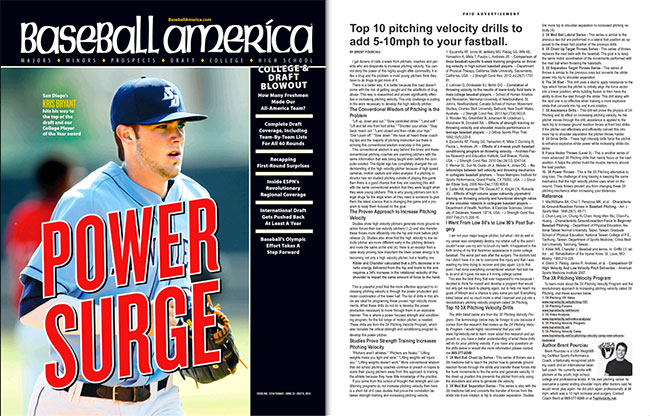
Baseball American Pitching VelocityFinally I got a spread in Baseball America! Seriously, my contacts at Baseball America where nice enough to post the article below for their readers and I wanted to share it with you. If you haven’t bought the March edition I would recommend that you run out and get it because it is AWESOME! Especially page 25 ;)

Baseball is America’s past time and because of this it is plagued by conventional wisdom. The movie, Moneyball is the perfect example of how this conventional wisdom has created an environment, in the recruiting process of a Major League organization, where the lower budget teams ability to compete against the big money teams is almost impossible. Until the likes of Billy Beane challenged the system, with an out of the box low budget approach, these big money teams always had an unfair advantage. Read more

Holy Grail Study Proves MLB Players Produce More Vertical Power

Brent Pourciau

by Brent Pourciau · February 10, 2013

MLB Players Produce More Vertical PowerYes, it is proven that the MLB has the highest verticals in the game of baseball. Not only that but when it comes to pure power production, no other level of professional baseball even comes close.

Did you really believe that the Major Leagues wasn’t made up of the bigger, stronger and faster athletes? Well if you thought otherwise then you where completely wrong. Matter of fact, it would be a good idea if you just forgot everything you know about baseball because I would bet most of it is not doing anything for you. It isn’t your fault though, but it is now your responsibility to learn the truth.

This game and most of the coaches in it have loaded you with complete BS for, more than likely, most of your career. Look on the bright side though you are reading this article, which means you are going to walk out of the cave when most of your peers are going to stay chained to the wall and continue believing the shadows to be real people. Read more

Research Proves Why Conventional Wisdom Is Ruining Pitchers Today

Brent Pourciau

by Brent Pourciau · October 16, 2012

Conventional Pitching Vs High Velocity Pitching“Up, Down and Out,” “Slow Controlled Stride,” “Keep balance and land soft on front leg.” How many pitching coaches and parents are regurgitating these coaching tips everyday to young pitchers? Too many to count! This poorly researched information is also plastered all over the web. This conventional wisdom is ruining pitchers and the latest research is proving this to be true.

A recent publication hosted at the US National Library of Medicine called, The Kinetic Chain in Overhand Pitching is a collaboration of research put together by some prominent medical doctors. These doctors include; Shane T. Seroyer, MD, Shane J. Nho, MD, Bernard R. Bach, MD, Charles A. Bush-Joseph, MD, Gregory P. Nicholson, MD, and Anthony A. Romeo, MD. In this comprehensive study of the bio-mechanics of the high velocity pitcher, they referenced some critical data proving the detrimental effects of inhibiting the hip and trunk movements during the stride, on the shoulder and arm of a pitcher. Here is an excerpt from this research citing a case study which produced this data: Read more

Flexibility And The High Velocity Pitcher

Brent Pourciau

by Brent Pourciau · September 17, 2012

Flexibility Training for the High Velocity PitcherBefore we dive straight into flexibility and the high velocity pitcher we need to first define what flexibility is and why is it so important to the high velocity pitcher. Conventional wisdom has this flexibility issue completely wrong. How many times have you heard your coach or a coach say that working out makes you tight and you need to be more flexible, but at the same time he is complaining that you do not throw hard enough? This should tell you that this is a coach who has a very poor understanding of the body and especially the high velocity pitcher.

Flexibility is the common word used to define a limber body that can easily bend and stretch, the problem is this doesn’t really define the high velocity pitcher. The high velocity pitcher does a lot more than just bend and stretch his body, he also generates power. If a high velocity pitcher is just bending and stretching but not generating power in return, then we do not have a high velocity pitcher. The question you should ask your coach is do you want me to just be flexible or do you want me to be both flexible and powerful like a high velocity pitcher? The picture above should prove your point. Read more

Pitchers Stop Living In Fear Of Weight Training

Brent Pourciau

by Brent Pourciau · August 14, 2012

Pitchers Stop Living in Fear of Weight TrainingBaseball is one of the last sports to embrace the performance benefits of weight training. The same fears that are coming from the conventional wisdom of the game of baseball existed even in football back in the 1950’s. Everyone was told that weight training would ruin the football player by making him bulky, slow, tight and injured. Sports like Football, basketball, all of the Olympic sports and even Golf have grown up to learn that this was not true. Weight training has helped to mold some of the greatest athletes in the world. Baseball is slowing coming around to this phenomenon but many of the conventional coaches in the game continue to live in ignorance and continue to beat this fear of weight training into the young players of this game. Read more

Study Proves Lateral Jumps Increase Pitching Velocity

Brent Pourciau

by Brent Pourciau · July 19, 2012

Chapman Lateral Jump Pitching VelocityThanks to Coach Robo, who recently brought my attention to a brand new case study on the Top Velocity forums, which actually tested the correlations of lower body power to throwing velocity. The case study was performed outside of the United States of America which makes perfect sense to me because the only way you are going to get an institute to break outside of the conventional wisdom of the game of baseball in this country, is if the institute is actually located outside of this country.

The documentation of the study actually begins by saying that there are numerous case studies proving that increased muscle strength and power do increase throwing velocity but the majority of these studies only focus on the upper body. Ahh, the ignorance of the culture of American Baseball, it is so refreshing! I have to congratulate the Aussies and the Canadians for not falling into this ignorance and searching outside of the box.  Read more

Pitchers Remodel More Fast-Twitch Muscle With Olympic Lifting

Brent Pourciau

by Brent Pourciau · March 21, 2012

Fast-Twitch Muscle Fiber, Olympic Lifting, PitchingTopVelocity.net has been a very controversial source of information within the conventional wisdom of the game when it comes to training the power pitcher. This is because 3X Pitching promotes the use of Olympic Lifting to develop any low velocity pitcher into a dominate high velocity power pitcher. The controversy has been going on for some time now and will continue until the conventional wisdom of the game adapts to the new discoveries of science. This article will plug some of these new and old studies that prove why the use of Olympic Lifting to build the power pitcher is so effective. Read more

Post-Activation Potentiation: A Pitching Velocity Phenomenon

Brent Pourciau

by Brent Pourciau · March 20, 2012

My biggest pitching idol growing up was Nolan Ryan. I worshiped his Pitching Bible like it was, “The Bible.” In this book he lists his everyday routines as a professional ball player, from what he ate to his strength training program. This was the first time I had ever heard about a pitcher lifting weights. What absolutely blew my mind was when he talked about his weight training circuit he would do just before pitching a game. I thought this was revolutionary. Why was he doing this and was it the secret to his success? I never discovered the answer to this question until trying it in my own career and also learning about a muscle phenomenon called, Post-Activation Potentiation. Read more

Pitching Velocity And The First Move

Brent Pourciau

by Brent Pourciau · October 25, 2011

Pitching Velocity First Move, First Move in Increasing Pitching Velocity There is no better way to increase pitching velocity than with a simple adjustment in your first move. Your first move begins with your leg lift. There are some major misconceptions with the purpose of your leg lift that need to be addressed before we can make the simple pitching velocity first move adjustments.

Let’s first get some footage of your pitching. Shoot some video of a few pitches of you pitching so we can analyze your first move in increasing pitching velocity. Make sure that this footage is shooting from a side perspective, chest facing the camera like Trevor Bauer here. Once you get your footage onto a computer, you then need to find a video player that will give you the ability to move frame by frame, so we can analyze each frame. Read more

Jump Farther Throw Harder

Brent Pourciau

by Brent Pourciau · September 26, 2011

Tim-Lincecum-jump.jpg The conventional response to the statement, Jump Farther , Throw Harder, would be that just because you can jump high, doesn’t mean you can throw hard. The conventional pitching coach might say, if this is true then why couldn’t Michael Jordan throw 95 mph when he played baseball? The conventional response would be the same if I said Lift Heavier, Throw harder or Run Faster, Throw Harder. The conventional pitching coach would say if this was the case, then why can’t Olympic lifters, body builders, Olympic sprinters throw hard? The answer to this is motor coordination. Read more

Arm Path And Pitching Velocity

Brent Pourciau

by Brent Pourciau · August 24, 2011

Arm Path, Pitching VelocityThere is one “Arm Path” to pitching velocity that all high velocity pitchers take. This “Arm Path” begins not where conventional wisdom would believe, which is after hand break, but in the cocked position at front foot strike. The funky delivery here of Zach Outman is a great example of how the “Arm Path” of the high velocity pitcher works. What makes his pitching delivery so different is because he starts his delivery with his arms above his head instead of the conventional way, which is in the glove below the head. This out of the box approach makes it easier for him to get his throwing arm into the prefect cocked position at front foot strike, so he can generate his top velocity. Read more

Weight Training Improves Flexibility For Pitchers

Brent Pourciau

by Brent Pourciau · August 22, 2011

Weight Training Improves Flexibility for PitchersA recent study has proven that weight training can improve flexibility as well as – or perhaps better than – typical static stretching regimens. This study was released at the American College of Sports Medicine’s 57th Annual Meeting on June 4, 2010. The study was labeled: STRENGTH TRAINING IMPROVES FLEXIBILITY, TOO – Preliminary research shows no advantage for stretching. You can read the full report here and this is the description of the report along with the results below. Read more

Proper Pronation Prevents Pitching Pain And Injury

Brent Pourciau

by Brent Pourciau · June 15, 2011

Pitching Pronation Prevents Pitching Pain and InjuryPitching pain and injury, along with most elbow problems come from overuse and poor mechanics. If we narrow it down to elbow pain then proper pronation is usually the determining factor. Proper pronation of the arm at release is when the thumb finishes down. Notice here in the picture of me in my last minor league season I am finishing with goo pronation.

Improper pronation at release can be the result of poor mechanics and aggressive off speed pitches. For proper pronation to occur in the throwing arm at release the pitcher must extend the arm to release. The improper release of the throwing arm which would prevent proper pronation would be to pull the arm down to release. I find this to be a major misconception in the conventional wisdom of the game. Physics proves that during the velocity phase of the throwing arm, the pivot or elbow, must remain stationary until after release. This means the elbow must extend to release to prevent the elbow from moving down during the throw. This not only supports pitching velocity but protects the elbow from resisting high amounts of deceleration forces. Extending the elbow to release also protects the rotator cuff during the deceleration of the arm. This will allow more of the back muscles to get involved during the deceleration phase. Read more

Pitchers Power Drive Position

Brent Pourciau

by Brent Pourciau · June 12, 2011

Pitchers Power Drive PoistionThink power and drive! The pitchers first few movements in his delivery is critical to his overall velocity. Just like a sprinters first step is more significant to his overall time than any other step in his sprint. If a pitcher fails to hit some key components in the beginning of his delivery then his pitching velocity will suffer. These key components would put the pitcher into his Power Drive Position.

There currently is a gimmick that supposedly helps the pitcher to get into this position but the problem with these gimmicks is if you cannot pitch with this device in a game, what use does it have for the pitcher? If the pitcher can not put himself into this power drive position without the device then it is a total waste of money. I have never worked with the device, so this is not a review.

The 3X Pitching Velocity Program trains the pitcher through drills to achieve this Power Drive Position. I will cover some of these components here that are in full detail in the 3X Pitching Velocity Program. Read more

Pitching Speed And The Glove

Brent Pourciau

by Brent Pourciau · May 13, 2011

Pitching Speed and the GloveThere is a lot of controversy around the glove side to pitching mechanics. Conventional Wisdom would coach the pitcher to pull down or pull around the glove side to launch the throwing arm into action. The problem is this would go against pure speed and classic physics.

The reality is that the glove arm to shoulder must act as a fulcrum for the shoulders during the throw to allow for efficient speed mechanics. To understand this we must first define the fulcrum. A fulcrum is the pivot about which a lever turns. The lever in pitching mechanics is the shoulders and also the hips but in this article we are only talking about the shoulders. The shoulders must swing like a door towards the target. Once they open then the arm must launch over the top of the door. If the pivot or fulcrum of the door is moving when the door is slamming closed then the door will not reach its top velocity. The same results would occur with other tools that use the fulcrum or pivot to swing a lever. Good examples similar to pitching, which I have used on this site, would be the catapult or mouse trap. Read more

Pitching Stride Length Equals Leg Strength

Brent Pourciau

by Brent Pourciau · May 2, 2011

Pitching Stride Length Equals Leg StrengthA Pitchers stride length is becoming more of a popular pitching component because of the data coming from the analysis of hard throwers. This data has been collected through video analysis and through the latest radar technology by Trackman. If you have not heard about this ground breaking technology and how it is making today’s radar gun obsolete then I suggest you read my latest article called 3D Doppler Radar Launches 3X Pitching. Read more

How To Gain 5 MPH On Your Fastball

Brent Pourciau

by Brent Pourciau · April 18, 2011

How to Gain 5 MPH on Your FastballAdding 5 MPH to your fastball can be a tough challenge if you do not know what you are doing. You definitely will not accomplish this using conventional wisdom. Old school approaches like extreme long toss, weighted balls or speed chains may get you close but the pitching speed increase will eventually go away or may not even transfer to the mound.

It is important to understand that you want to add 5 MPH to your fastball on the mound, not only on flat ground. Throwing from the mound uses  a different kinematic sequence than on flat ground. This must be a main focus of the velocity enhancement program.

When I developed the revolutionary approach to pitching velocity called 3X Pitching, I first analyzed some of the hardest throwers in the game to try and discover their secrets. I wasn’t as interested in their training programs because most of these hard throwers, I felt, had superior genetics. I knew that if I could learn what they were doing mechanically, which was causing them to throw so hard, I could then try to emulate these mechanics through training my body to move like theirs. I believed that this was a good strategy for success. I soon learned that this was true. Read more

Why Some Pitchers Throw Harder Than Others?

Brent Pourciau

by Brent Pourciau · October 31, 2010

Pitchers Throw Harder, Hard Throwing Pitchers, Why Some Pitchers Throw Harder Than OthersWhy Some Pitchers Throw Harder Than Others is a big question in baseball and it is a question that seems to continue to go unanswered. Determining why some pitchers throw harder than others was the basis for a study by the American Sports Medicine Institute, the School of Health & Sports Sciences Osaka University and the Department of Surgery Duke University. The study was called KINEMATIC DIFFERENCES BETWEEN HIGHLY-SKILLED AND LESS-SKILLED BASEBALL PITCHERS. This study took place in 1999.

I wanted to title this article, “Why Some Athletes Throw Harder than Others?” but conventional wisdom does not label pitchers as athletes yet so I didn’t want to confuse anyone. I hope I can help change this perspective of us Pitchers in the near future. Read more