Proper Pronation Prevents Pitching Pain and Injury

June 15, 2011

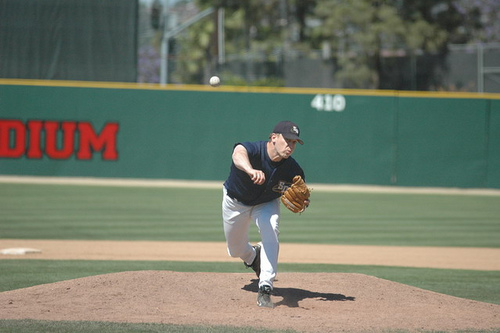
Pitching Pain and InjuryPitching pain and injury, along with most elbow problems come from overuse and poor mechanics. If we narrow it down to elbow pain then proper pronation is usually the determining factor. Proper pronation of the arm at release is when the thumb finishes down. Notice here in the picture of me in my last minor league season. Improper pronation at release can be the result of poor mechanics and aggressive off speed pitches.

For proper pronation to occur in the throwing arm at release the pitcher must extend the arm to release. The improper release of the throwing arm which would prevent proper pronation would be to pull the arm down to release. I find this to be a major misconception in the conventional wisdom of the game. Physics proves that during the velocity phase of the throwing arm, the pivot or elbow, must remain stationary until after release. This means the elbow must extend to release to prevent the elbow from moving down during the throw. This not only supports velocity but protects the elbow from resisting high amounts of deceleration forces. Extending the elbow to release also protects the rotator cuff during the deceleration of the arm. This will allow more of the back muscles to get involved during the deceleration phase. Read more

Olympic Lifting Increases Pitching Velocity

June 12, 2008

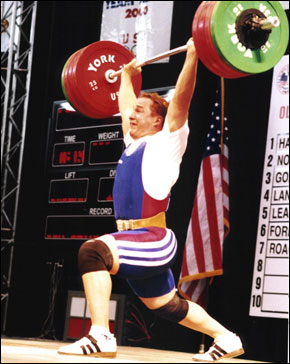
Weight Training and Velocity, Strength Training and Pitching Velocity, Olympic Weight Lifting and VelocityBoth Strength Training and Pitching Velocity are NOT on different ends of the spectrum of sports as conventional wisdom would have you believe. Specifically Olympic Weight Training and Velocity are both closely related and this article will help explain how and why.

To understand the effects of Olympic weight lifting and velocity on pitchers, you must first understand how velocity is measured. I will use Newton’s second law of motion, along with the Catapult Theory, to explain pitching velocity.

Newton’s Second Law:

States that the acceleration (velocity) of an object in motion is dependent upon two variables – the net force acting upon the object and the mass of the object. As the force of propulsion acting upon the object increases, the acceleration of the object increases. As the mass of the object increases, the acceleration of the object decreases.

Newton’s 2nd Law of Motion

a = f/m (f = force, m = mass, a = acceleration)

Let’s put this into baseball terms. Newton’s second law of motion would state that to throw a baseball 90 mph would require 6.5 pounds of pressure applied to a baseball, with a mass of 5 ounces, for two tenths of one second (.20). Read more