Top 3 Pitching Power Issues

June 12, 2011

Top 3 Pitching Power IssuesAs a pitcher do you train for power? The more I coach and train pitchers with 3X Pitching the more I want to spend  most of my time training them in the weight room.

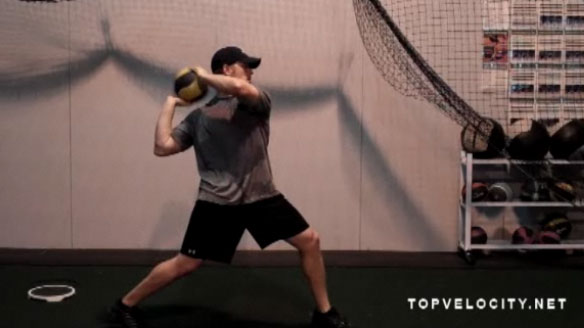
All of the 6 components of 3X Pitching Velocity are representative of a ballistic or explosive movement during a specific point in time. If the pitcher tries to implement these components into their deliver as choreography then the final result will be negative. It is critical that you use drills to develop the motor coordination of each component of the delivery as you move through the entire sequence. This way the final result will always be positive.

This is the revolutionary approach behind 3X Pitching. The problem is most pitchers who start 3X Pitching are searching for a program to help them increase velocity. This means they have mechanical issues and most of these mechanical issues are the negative results of the lack of power in their deliveries. Read more

3X Pitching Superior to Extreme Long Toss

May 21, 2011

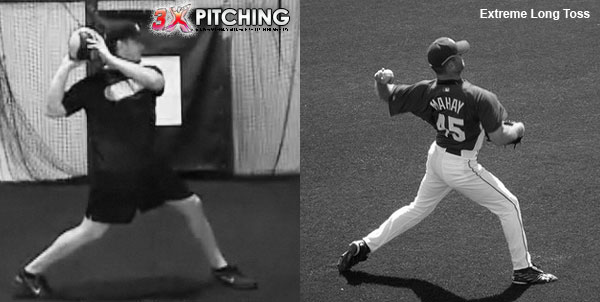
3X VS Long TossThe argument behind extreme long toss is that the pitcher will learn how to take the velocity of a 300 foot throw and transfer it into a 60 foot throw. This is what I learned from watching an interview with Alan Jaeger who uses extreme long toss with yoga to develop pitchers.

If you have been following this site then you know that I am totally against this approach to pitching. Here is a quick summary of why I am against this type of training. The American Sports Medicine Institute (ASMI) proves in their latest case study here that this type of long toss creates elbow varus torque in the arm and uses different mechanics than those used on the mound. In defence, Alan Jaeger says that the athletics of the 300 foot throw when restricted to 60 feet, through his “Pull Down” phase, forces the pitcher to be more open and explosive. Read more

Elastic Energy = Pitch Velocity

August 26, 2009

NomoI have already made the argument that the body generates the velocity of the pitch and not the arm. This article will continue to prove this point and give the pitcher a better understanding of how velocity is generated.

Dr. Jobe FW, Dr. Tibone JE, Dr. Perry J, Dr. Moynes D performed a case study called An EMG Analysis Of The Pitching Shoulder. This study is the proof that the accelerator muscles in the arm do not fire when the arm is moving forward. Which means the arm muscles do not activate to generate the velocity of the pitch. Here is a summary of the study. Read more

Resisted Sprints and Effects on Kinematics and Sprint Speed

August 24, 2008

by Chad Englehart

Speed Training

Implied in any linear speed discussion with a Strength and Conditioning Specialist, is the concept of resisted speed training strategies. Some professionals consider resisted speed training as the most efficient sprint training technique on the planet, while other consider it not as effective because of a biomechanical stand point. Different resisted speed strategies include, towing, uphill sprints, sand sprints, and weighted sprints. Tahachnik (1992) explained that towing of weighted devices such as sleds and tires is the most common method of providing towing resistance for the enhancement of sprint performance, although the use of parachutes has also Read more