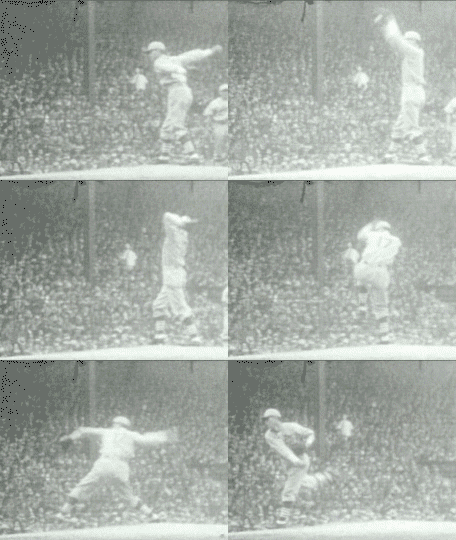
What is Momentum Pitching?
June 14, 2009
The online world of pitching experts have been throwing around the buzz word “Momentum pitching” recently. This isn’t anything new unless you are up to date on the breakthroughs of pitching science. Pitchers have been trying to find better ways to generate more momentum in their deliveries for years but what is changing is the science behind this matter.
During the prime of the likes of Nolan Ryan, the popular way of generating more momentum back then was the “Stand Tall and Fall” style developed by Nolan Ryan and his pitching coach Tom House, who may have coined the term. This proceeded the popular style of “Drop and Drive” used by the great Tom Seaver. These two styles of pitching are still used today. What is changing is pitching mechanics are evolving from an art form into the world of science. Read more
“Triple Extension” Creates Optimal “Separation.”
June 6, 2009
For all of those pitchers who are trying to develop more separation in back hip to back shoulder you will only achieve this with triple extension of the drive leg. “Triple Extension” is extension of the ankle joint, knee joint and the hip flexor. You must perform this in your drive leg so your back hip can open completely to the target. If you keep your shoulders and weight back while you perform”Triple Extension” optimal “Separation” will occur. Read more
Tim Lincecum Teaches Top Velocity
May 5, 2009
There are two forces that add velocity to a pitch:
Momentum
Rotational Torque
For momentum to effectively transfer to the ball, the pitcher must use all rotational pivots in order from the bottom up. The hips must rotate before the shoulders and the shoulders before the arm internally rotates. For this to happen effectively these pivots must be free to rotate completely. Notice the picture of Tim Lincecum at the bottom of the page (Tim Lincecum is a phenom because of his size and ability to reach his top velocity continuously.) Notice in the picture his weight is slightly leaning to his left. This would be like tilting an open door backwards so the open door slams closed due to gravitational forces. This gravitational pull is helping to create full range of motion in Tim Lincecum’s hips and shoulders at front foot strike. If he or the door was tilted the opposite way then these gravitational forces would work against his momentum by decreasing full range of motion in his rotational pivots. Using the force of gravity to increase the range of motion in your hips and shoulders will have a significant effect on your velocity. This is a big reason why Tim Lincecum can throw so hard for his size. He is working with the forces of nature to generate his power. Read more
Does Velocity Come from the Arm or the Body?
April 16, 2009
The arm throws the ball but does it generate the velocity in a 90+ mph fastball?
This question can stir up a big argument but there is only one answer. The arm does not generate the velocity. It only guides the pitch. Therefore the arm must follow the body and does not come into play until the body has done its job. Read more
The Pitching Windup vs Stretch
March 8, 2009
I get this question a lot, “the windup vs the stretch, what is better?” The problem is the windup is almost sacred to the game of baseball but it really has no purpose besides a kind of confidence builder on the mental state of the pitcher. The windup represents the old style of pitching from back in the day when the pitchers would use the windup to get their arms moving faster like in the video clip here of Dizzy Dean. Now that we have learned that doing this is destructive to pitching velocity, the windup has become just an extra step to throwing in the stretch. Read more