pitcher Pitching Articles

Here are some pitching articles on this important pitching velocity topic. This topic is currently open for discussion. You can either comment on the articles below or start a thread in the pitching forums.
The Secret To Increasing A Pitcher’s RPM’s And K’s

by Brent Pourciau · May 7, 2012
This is an exciting time for baseball because science is starting to have a major impact on the game. A sign of this impact has been the increase in pitching velocity across the board. We are hearing more and more about 100 mph pitchers coming out of high school and college ball today. Pre-Steroid ERA this would have been unheard of.
TopVelocity.net has been at the forefront of this cutting edge information. What we have done here is interpret this new scientific data into laymen’s terms to help the young pitcher benefit from it. One of the latest studies to come out, which shows the relationship of pronation speeds to vertical ball movements, is some of this cutting edge science that has been right under our noses but now that it is documented, it will begin to impact the game. Read more
Comparison Of High Velocity And Low Velocity Pitch Deliveries

by Brent Pourciau · June 18, 2009
Stodden DF, Fleisig GS, McLean SP, Lyman SL, Andrews JR. Relationship of pelvis and upper torso kinematics to pitched baseball velocity. Journal of Applied Biomechanics 17(2):164-172, 2001.
Matsuo T, Escamilla RF, Fleisig GS, Barrentine SW, Andrews JF. Comparison of kinematic and temporal parameters between different pitch velocity groups. Journal of Applied Biomechanics 17(1): 1-13, 2001.
Stodden, DF, Fleisig, GS, McLean, SP, Andrews, JR. Relationship of Biomechanical Factors to Basebal Pitching Velocity: Within Pitcher Variation. Journal of Applied Biomechanics 21(1): 44-56, 2005 Read more
What It Takes To Gain Pitching Velocity

by Brent Pourciau · June 17, 2009
If you haven’t figured it out yet, pitching velocity doesn’t come in a pill. Sorry to bust your bubble but it takes a lot of hard and smart work to develop it. If you are looking to gain 4-5 mph on your fastball then you must work to improve in all facets of pitching. These facets include: Read more
What Is Momentum Pitching?

by Brent Pourciau · June 14, 2009
The online world of pitching experts have been throwing around the buzz word “Momentum pitching” recently. This isn’t anything new unless you are up to date on the breakthroughs of pitching science. Pitchers have been trying to find better ways to generate more momentum in their deliveries for years but what is changing is the science behind this matter.
During the prime of the likes of Nolan Ryan, the popular way of generating more momentum back then was the “Stand Tall and Fall” style developed by Nolan Ryan and his pitching coach Tom House, who may have coined the term. This proceeded the popular style of “Drop and Drive” used by the great Tom Seaver. These two styles of pitching are still used today. What is changing is pitching mechanics are evolving from an art form into the world of science. Read more
Triple Extension Pitching Creates Optimal Separation

by Brent Pourciau · June 6, 2009
For all of those pitchers who are trying to develop more separation in back hip to back shoulder, you will only achieve this with explosive triple extension of the drive leg. “Triple Extension” is the extension of the ankle joint, knee joint and the hip flexor. You must perform this in your drive leg so your back hip can open completely to the target. If you keep your shoulders and weight back while aligning your Force Vector and once your Force Vector is linear you perform”Triple Extension,” optimal “Separation” will occur. Read more
Why Pitchers Should ICE Their Arms?

by Brent Pourciau · May 9, 2009
There is a lot of controversy around pitchers and icing their arms post game. After surgery I was very strict when it came to icing post game. I know that it isn’t enough for me here to just say that, “Hey, I did it, so you should too.” So, I took some time to research the web and I found several websites reference the work of Dr. Meeusen from Antwerp, where I played some professional baseball. He based his life study around icing as a means to help heal a damaged muscle. His documentation describes how ice can be effective and where it can cause problems.
Research by Dr. Meeusen on Icing a Pitchers Arm
Tim Lincecum Teaches Top Velocity

by Brent Pourciau · May 5, 2009
There are two forces that add velocity to a pitch:
- Momentum
- Rotational Torque
For momentum to effectively transfer to the ball, the pitcher must use all rotational pivots in order from the bottom up. The hips must rotate before the shoulders and the shoulders before the arm internally rotates. For this to happen effectively these pivots must be free to rotate completely. Notice the picture of Tim Lincecum at the bottom of the page (Tim Lincecum is a phenom because of his size and ability to reach his top velocity continuously.) Notice in the picture his weight is slightly leaning to his left. This would be like tilting an open door backwards so the open door slams closed due to gravitational forces. This gravitational pull is helping to create full range of motion in Tim Lincecum’s hips and shoulders at front foot strike. If he or the door was tilted the opposite way then these gravitational forces would work against his momentum by decreasing full range of motion in his rotational pivots. Using the force of gravity to increase the range of motion in your hips and shoulders will have a significant effect on your velocity. This is a big reason why Tim Lincecum can throw so hard for his size. He is working with the forces of nature to generate his power. Read more
The Pitching Windup Vs Stretch

by Brent Pourciau · March 8, 2009
I get this question a lot, “the windup vs the stretch, what is better?” The problem is the windup is almost sacred to the game of baseball but it really has no purpose besides a kind of confidence builder on the mental state of the pitcher. The windup represents the old style of pitching from back in the day when the pitchers would use the windup to get their arms moving faster like in the video clip here of Dizzy Dean. Now that we have learned that doing this is destructive to pitching velocity, the windup has become just an extra step to throwing in the stretch. Read more
The Split Perspective Of Separation

by Brent Pourciau · February 17, 2009
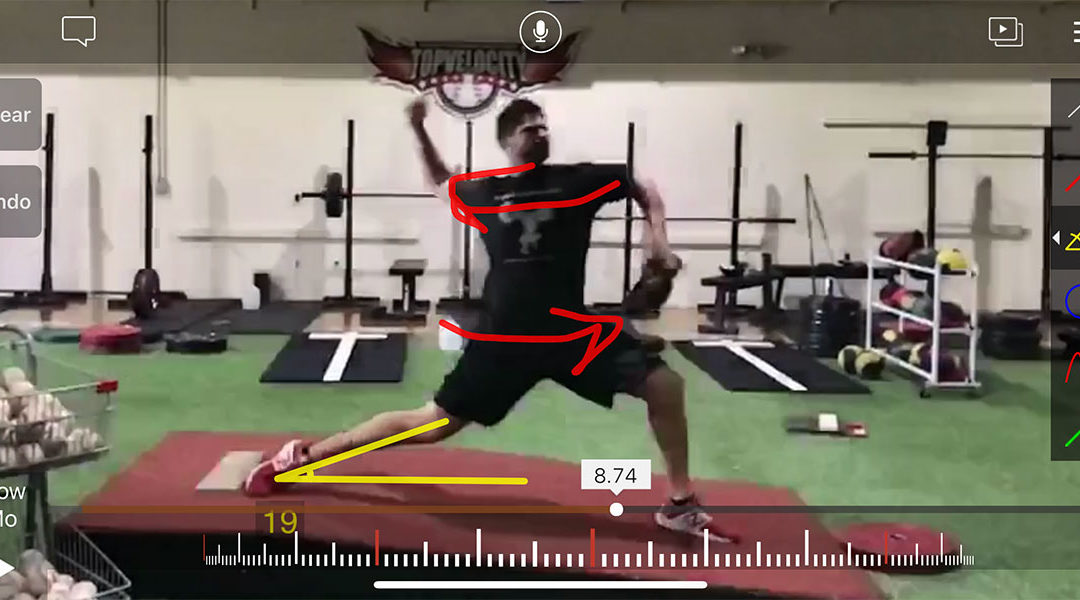
Separation is a major component to developing top velocity and longevity. Separation means having separation from your back hip to back shoulder at front foot strike. Notice the picture here of Felix Hernandez. His back hip is pointing towards home plate and his back shoulder is pointing towards second base. This creates torque in the core. You can see the stretching in his jersey around the stomach area. Having more torque in the core instead of the shoulder of the arm will lead to more velocity and a healthier arm. Read more
The Hip Slide To Pitching Velocity

by Brent Pourciau · February 12, 2009
The biggest problem I find in young pitchers is that they have poor separation in their hips to shoulders. There are many articles on this site covering the pitching component “Separation.” It is so important because having separation from your back hip to back shoulder before the shoulders rotate to the plate, is critical for velocity and the health of your arm. What “Separation” does is it builds core torque. It puts more torque in the big muscle groups of the core, instead of mainly in the small muscle groups of the shoulder. Read more
Bad Pitching Mechanics Is A Sign Of Muscular Weakness

by Brent Pourciau · February 10, 2009
Above average coordination is a sign of fast twitch muscle strength. Fast twitch motor neurons recruit more muscle fibers. This means more control of the body and also more explosive power. The biggest problem for a pitching coach, when working with a pitcher who does not have good hip rotation or who does not load and build a full body stride, is that this is the result of poor core and leg strength and no mechanical drill will fix this problem.
Drills only help pitchers who are having a hard time changing flawed muscle memory. It doesn’t help pitchers who have good muscle memory but poor muscle strength. This is why we have weight rooms. This is why any coach who tells you that weight lifting will NOT help you as a pitcher is clueless and is wasting your time and maybe even your money. A good strength and conditioning program that incorporates Olympic lifts, plyometric training and an intense speed training program is essential to developing good pitching mechanics. Good athletes make good pitchers. Read more
Boost Your Testosterone And Growth Hormone Levels Naturally

by Brent Pourciau · February 1, 2009
Using steroids and growth hormone (GH) injections to increase your levels of testosterone and GH has more bad side effects than positive returns. This is why I speak against these illegal drugs. Through proper strength and conditioning, an athlete can naturally stimulate their bodies testosterone and GH levels. The reason for athletes increasing these levels is to grow bigger, stronger, faster, which means your body is healing faster than it is breaking down. This is very beneficial for pitchers because quicker recovery between appearances will result in more velocity, better consistency and less chance of injury. This is why the Michell Report was full of professional pitchers using these illegal substances. These pro pitchers were looking for the hormonal edge but going at it in the wrong direction. Thank you to the strength and conditioning world, we have now learned that the hormonal edge can be obtained naturally, through a proper strength and conditioning program. Read more
Fast Twitch Pitching

by Brent Pourciau · January 28, 2009
Professional Baseball is full of genetic freaks. Long and slender pitchers who throw mid to upper 90′s like A.J. Burnett and Aroldis Chapman. At this moment, Major League scouts are combing the earth looking for these rare specimens. This is why it is so exciting when someone like Tim Lincecum at 5’9 170 pounds, throwing 95 mph, comes along and blows everyone’s mind. Yes, Tim is a new kind of freak but what he proves is that throwing hard can also be a little mans game. Tim is evidence that the strength and conditioning world is not just hype. It is real and it is the fountain of success for any athlete. It teaches why someone like Tim Lincecum throws as hard as someone the total opposite in size, like A.J. Burnett or Aroldis Chapman. Why doesn’t Major League Baseball teach little guys to throw as hard as big guys? Because they do not have too. Major League Baseball is like a spoiled child. It gets everything it wants. Therefore, they have no need to make what they already have. Read more
Pitcher’s It Is Time To Start Juicing!

by Brent Pourciau · January 20, 2009
After my almost career ending rotator cuff injury, I decided to devote myself to understanding the body so I could somehow find a way back to the game I love. What I learned was I had bad mechanics as a young pitcher. I also learned that I did not train enough or when I trained it was completely wrong. I also learned that my diet was that of a dog and not a diet of a high performance athlete. It is important, as athletes, that we eat the balanced diet we have been told about all of our lives. We avoid listening to these words of wisdom because we eat what we want to eat. The reality is most young athletes have not faced a career ending injury. If someone was to tell you that you could avoid any serious injury in sports and prolong your career as an athlete, if you eat 5-6 servings of vegetables a day, would you do it? Read more
How A BAD Pitching Coach Can Ruin A GOOD Pitcher

by Brent Pourciau · January 18, 2009
Ultimately, your pitching Coach is your boss. If you piss him off, there is a good chance you may be out of a job. The problem is if he is a BAD pitching coach, he could jeopardize your career. It has happened many times before. The key is to keep the Coach happy, while you find the best support you can, to help influence your career.
What makes a BAD pitching Coach?
Someone who has no experience in playing the position at the top levels of the game, or someone who has no certified education of how to coach the position. Read more
Overload To Underload – Right Concept, Wrong Approach

by Brent Pourciau · January 14, 2009
Using the overload to underload approach to train a young pitcher’s arm and central nervous system to increase arm speed is the right concept but the wrong approach when using weighted baseballs on a young pitcher. The problem is with using weighted baseballs on a young pitcher, who more than likely does not have the motor coordination of high velocity mechanics, is that it sacrifices the arm to teach the body how to move weight more efficiently and quickly. To understand how backwards this weighted baseball approach is for the young pitcher we must first look at what role the arm plays in the entire pitching delivery. Read more
Long Toss And The Placebo Effect

by Brent Pourciau · January 13, 2009
Long toss is praised by many and shot down by few. I have heard the likes of Alan Jaeger preaching long toss as the secret to velocity and the likes of Dick Mill’s trying to prove scientifically why you should never do it again. I have reflected on this topic for some time now. In my career, I did a lot of long toss but rarely did I notice any difference in velocity. I refuse to tell you that long toss is a waste of time but what I will do is share with you the Pros and Cons of this kind of practice. It is then up to you to make your own decision on using long toss in your training regime. Read more
Poor Posture Causes Injury And Decreases Pitching Velocity

by Brent Pourciau · January 12, 2009
Poor posture is a sign of weakness and laziness. Because it is seen as being “Cool” to lounge around in class or hanging out somewhere, this is causing poor posture in young athletes today. DO NOT ALLOW THIS TO HAPPEN TO YOU. Poor posture will lead to an arm injury, especially in pitchers. If this is you, then you must read this article.
How to Avoid an Impingement
Notice the image below of the subacromial space. When the arm is relaxed and down, there is enough room for the shoulder to rotate internally and externally but when the arm is raised above the head, in a throwing position, the subscromial space is almost closed. This can easily cause an impingment of the rotator cuff muscle, mainly the supraspinatus. Poor posture makes this even worse. This is because the shoulders are forward and the acromion is positioned more on top of the supraspinatus muscle impinging the muscle even more. With poor posture and the constant internal rotation of the arm during a pitch, over time this will start to tear the muscle. This could lead to a complete tear of the rotator cuff. Read more
What You Need To Know About The Pitching Shoulder

by Brent Pourciau · January 9, 2009
This article is for every athlete out there. I am an athlete, who overcame a career ending rotator cuff tear in college, to pitch again and make it to minor league ball. I was told I would never pitch as hard as I did before the tear. I topped out at 94 mph my last season for the San Diego Surf Dawgs, over eight years later. That was more than 8 mph from before surgery. It was a long road and I am here today to teach you everything you need to know on how to prevent this from happening to you. Read more
Just Say NO To Long Distance Running

by Brent Pourciau · January 8, 2009
If your Coach or Trainer has you running for longer than five minutes at a SLOW pace then you are training to be just that, SLOW! Muscles have a mixture of two basic types of fibers, fast twitch and slow twitch. Fast-twitch fibers are capable of developing greater forces and contracting faster and have greater anaerobic capacity. Anaerobic means exercise without the use of oxygen as an energy source; short bursts of vigorous exercise. Sprinting is an anaerobic exercise. In contrast, slow-twitch fibers develop force slowly, can maintain contractions longer and have higher aerobic capacity. Aerobic means exercise in which energy needed is supplied by oxygen inspired and is required for sustained periods of vigorous exercise with a continually high pulse rate. Long distance running is an aerobic exercise. Read more