Pitches, Pitches, Pitches and more Pitches
February 24, 2011
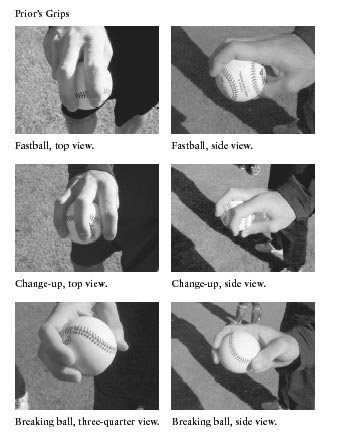
Those who lack velocity want to throw more pitches. The problem is this is a double edged sword. When your velocity is poor, and you want to take the easy way out, you opt for ball movement. This involves trying, or successfully learning, offspeed pitches. Here is a list of these type of pitches.
Offspeed Pitches:
- Curveball
- Slurveball
- Circle Change
- Forkball
- Knuckleball
- Gyroball
- The “Volken”
I am not saying that these pitches are junk or a waste of time, because many great pitchers have used them. What I am saying is this is always last resort. Especially when you are young. You should expect your velocity to improve all the way into your 20′s. If you have plateaued, then you need a velocity enhancement program like 3X Pitching and the Ace Pitcher Handbook before you need to learn another pitch. Also learning these offspeed pitches have proven to decrease velocity, because if not thrown correctly, it can add more wear and tear to the arm and it also can change your mechanics. I have seen in my career guys loss a few miles per hour because they fell in love with a Forkball, or a Curveball. I am not saying this is the case for everyone but it is the case for most young pitchers. Read more
The 3X Power Stride
January 11, 2011
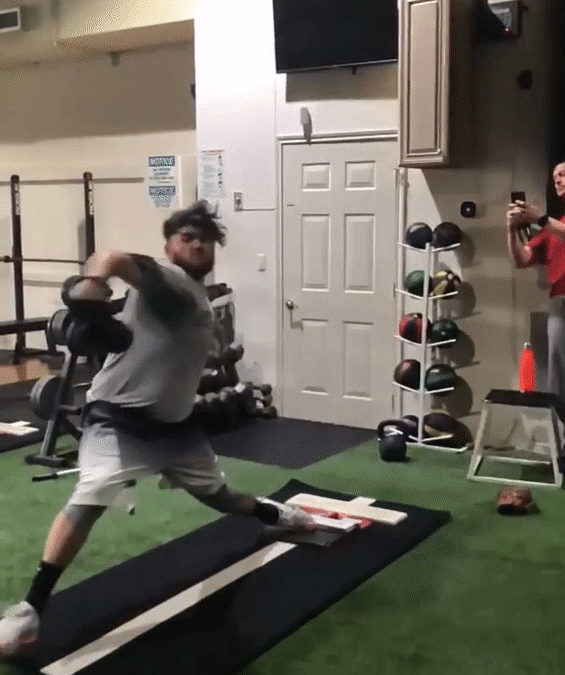
Most young pitchers do not have the leg power (power is strength and speed) necessary to generate the energy needed, through the stride, to reach their top velocity. If you are a pitcher who uses mainly your arm to generate velocity then you will find yourself shortening your stride to quickly get your front foot planted. After front foot strike you then will use your glove side and throwing arm to generate most of your velocity. Not only is this approach to pitching not efficient, it puts unnecessary wear and tear on the rotator cuff. Learning how to use the stride to generate power to be transferred into the ball as velocity is far superior than the later approach. Read more
Overload to Underload – Right Concept, Wrong Approach
January 14, 2009

Using the overload to underload approach to train the pitchers body and central nervous system to increase arm speed is the right concept but the wrong approach when using weighted balls. The problem with using weighted balls is that it sacrifices the arm to teach the body how to move weight more quickly. To understand how backwards this weighted ball approach is we must first look at what role the arm plays in the pitching delivery. Read more
Little League Pitching
December 3, 2008
One of the most common questions I get as a Coach is, “How old should a kid start pitching?” I was pretty young myself but then again I also had major shoulder surgery in college. With my experience I would say, “Wait as long as you can to start making pitching your number one position.” If you have the dreams of playing Pro ball one day, I would definitely keep your arm as fresh as possible. Pro scouts drool over live fresh arms. Their eyes pop out of their heads when they learn that a young live arm has little time spent on the mound. So that being said, focus more on throwing mechanics than getting time on the hill in the little league to junior high ranks. Read more
Separation, the Safe Zone and the Power Curve
October 11, 2008
I just read Chris Oleary’s article on the “Safe Zone.”
http://chrisoleary.com/projects/Baseball/Pitching/PitcherInjuryAnalysisProject/Patterns.html
It is always nice to find unconventional thinking when it comes to pitching instruction. I recommend you read his article. I was forced in my early career to overcome a serious shoulder injury, because I wasn’t taught this important piece of information. Ever sense my almost career ending injury, I have been coaching this theory, but never referred to it as the “Safe Zone.” I will now!