

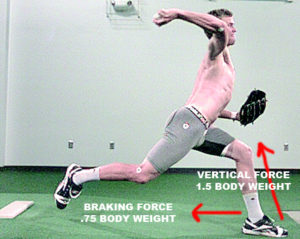
 The moment of front foot strike in the power pitching delivery is critical, this is when power is converted into torque. The more power a pitcher can generate at front foot strike then the more potential to generate high amounts of torque in the elastic muscles of the body. There has been a lot of controversy around this topic and it is time to set the record straight.
Many conventional coaches would coach a soft landing at front foot strike and many of these coaches would be reducing a pitchers ability to build torque and increase pitching velocity. The science today now proves that high velocity pitchers apply more force into the ground at front foot strike than low velocity pitchers. Let's look at this science along with some "Big" League high velocity pitchers, so we can learn how to benefit from this cutting edge information.
The Scientific Proof that Hard Throwers Land Hard

The first case study listed here was also referenced in my previous article on the effects of the lower extremity on pronation speeds. The study was performed at the Department of Orthopedic Biomechanics, Johns Hopkins University, Baltimore, Maryland and is called, Characteristic ground-reaction forces in baseball pitching. Here are the results of the study:
Pitchers were found to generate shear forces of 0.35 body weight in the direction of the pitch with the push-off leg and to resist forces of 0.72 body weight with the landing leg. Wrist velocity was found to correlate highly with increased leg drive. This study validates the clinical impression that the lower extremity is an important contributor to the throwing motion. Based on this study, strengthening of the lower extremities could be inferred to be important both to enhance performance and to avoid injury.
Read the entire study here: http://www.ncbi.nlm.nih.gov/pubmed/9474404
This study used college and high school level pitchers. It is stating that the forces on the landing leg where much greater than the forces on the drive leg; 0.72 body weight to be exact. It also implies that as the forces increased on the legs, so did the velocities of the wrist. This means that more ground reaction forces, specifically at front foot strike, increased wrist velocities.
Here is another piece of data from Popular Science which is an American magazine founded in 1872 which covers topics related to technology and science. This is from their article called, The biomechanics behind throwing 100 mph without ripping your elbow apart. The article states:
175% of Body Weight - Average force with which the front leg comes down. For a 220 pound pitcher like Joel Zumaya, that's 394 pounds.
Read article here: http://www.popsci.com/how-it-works/article/2008-07/how-it-works-fastball
This article does not explain where it gets its data from but the numbers are very similar to the study above. I believe it is fair to say pitchers with good linear drive power are landing with around 175% of their body weight. This would be like performing a power clean at 175% of your body weight and driving the weight up and catching it on your upper chest, with one leg, as you stabilize the weight and drive it up to finish. This is more proof that high velocity pitchers need to have incredible leg strength to stabilize their linear power at front foot and convert into elastic energy.
This last study supports the argument by proving that the muscle activity in the legs during the stride phase can reach over 172% of maximal voluntary isometric contraction (MVIC). The study was performed by the Biomechanics/Motor Behavior Laboratory School of Human Movement, Sport and Leisure Studies, Bowling Green State University, Bowling Green, Ohio. The study is called, Lower extremity muscle activation during baseball pitching. Here are the results from the study:
The pitching motion was divided into 4 distinct phases: phase 1, initiation of pitching motion to maximum stride leg knee height; phase 2, maximum stride leg knee height to stride foot contact (SFC); phase 3, SFC to ball release; and phase 4, ball release to 0.5 seconds after ball release (follow-through). Results indicated that trail leg musculature elicited moderate to high activity levels during phases 2 and 3 (38-172% of MVIC). Muscle activity levels of the stride leg were moderate to high during phases 2-4 (23-170% of MVIC). These data indicate a high demand for lower extremity strength and endurance. Specifically, coaches should incorporate unilateral and bilateral lower extremity exercises for strength improvement or maintenance and to facilitate dynamic stabilization of the lower extremities during the pitching motion.
Read the entire study here: http://www.ncbi.nlm.nih.gov/pubmed/20300031
With all this data, it is safe to say that high velocity pitchers land with more force than low velocity pitchers. It even promotes a stronger leg drive to increase this force production which in turn will speed up wrist velocities. To take this one step further let's take a look at an elite group of high velocity pitchers who are known to generate a lot of force at front foot strike.
Hard Throwing "Big" League Pitchers
Let's just say these MLB pitchers below put the "Big" in Big League. Yes, these group of elite pitchers are known to carry extra baggage to the field and I don't mean equipment. Ok, enough with the bad jokes! What all these pitchers below have in common is they all weight more than 250 lbs and they throw harder than 90 mph. Most of them have been very successful pitchers. This extra weight is what makes them so important to this argument that hard throwers do not land soft but hard. If this was not true then physics would say that there would be no way that these guys could throw so hard. I mean if landing softer meant throwing harder then these guys shouldn't be able to break glass but this is obviously not the case here. These "Big" Big League pitchers are proof that more force at front foot strike means the potential for more speed.
So before you head out to the closest fast food joint and stuff a few to many double beef patty supremes with extra cheese BIGGY sized down your face there is a better alternative. How about stop listing to the conventional wisdom of the game and start bringing some force to your front leg? How about learning the stride phase and how to enhance power production through it to increase more front foot ground reaction forces instead of playing long toss all day or using weighted ball training?
Maybe the reason an incredibly small percentage of pitchers throw in the 90's and an incredibly large percentage of pitchers train the same way is because the conventional wisdom of the game is not helping pitchers get better. Did you ever think that the information you are being feed in your career is what is preventing you from living the dream? If not then I hope this article helps you question how you are being coached to play this game!


landing hard on the front leg to get knee behind heel.. is it possible to have a slight throwing of the lead foot to enable that? i kinda feel like days when i have my best power i use the front foot to stop when sometimes ill use the front foot to “pull” momentum forward…
2nd case clearly is a result of lacking drive power and making up for it
when you 3x and about to land, do you extend the front leg at touch down to land hard and fast?
Yes, you may need to throw out the front leg a little just before front foot strike if you are struggling with landing knee behind heel. As you develop more stride power your ankle kick should do this for you.
You want to land at front foot strike with a bend in your landing leg knee and move into front leg extension before pitch release.