Stride Length Equals Leg Strength
May 2, 2011
Stride length is becoming more of a popular pitching component because of the data coming from the analysis of hard throwers. This data has been collected through video analysis and through the latest radar technology by Trackman. If you have not heard about this ground breaking technology and how it is making today’s radar gun obsolete then I suggest you read my latest article called 3D Doppler Radar Launches 3X Pitching. Read more
Triple Extension – 3X Pitching
January 27, 2010
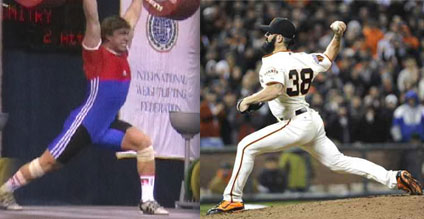
The topic of Triple Extension in the Pitching delivery is growing more attention. I first brought the teachings of triple extension from Olympic Lifting into the Pitching world when I launched TopVelocity.net. I continue to believe that Triple Extension, or the acronym 3X, is a major component of velocity. Triple Extension is the extension of the ankle joint, the knee joint and the hip flexors. The best way to understand and visualize 3X is when jumping. When you jump, you triple extend these 3 joints as your body drives itself off the ground. The problem with learning 3x and pitching, is that it must come after learning good hip to shoulder separation. The reason most coaches do not coach driving off the mound is because they do not know how to teach hip to shoulder separation before teaching driving the back leg. Teaching 3X without teaching good separation is like putting the cart before the horse. It doesn’t work and therefore most coaches totally avoid the entire 3X approach. Read more
The Phenomenon of Speed Mechanics!
January 9, 2010
We have all heard about the importance of Momentum in pitching but do we really know what it means? Velocity is a product of Momentum and Rotational Torque. I believe that Top Velocity is achieved when both rotational torque and momentum meet. The problem is we all understand rotational forces when throwing but momentum seems to be a lot harder to truly understand and implement into our deliveries. To truly understand Momentum, I have coined a new term, along with its description. Read more
Comparison of High Velocity and Low Velocity Pitch Deliveries
June 18, 2009
Stodden DF, Fleisig GS, McLean SP, Lyman SL, Andrews JR. Relationship of pelvis and upper torso kinematics to pitched baseball velocity. Journal of Applied Biomechanics 17(2):164-172, 2001.
Matsuo T, Escamilla RF, Fleisig GS, Barrentine SW, Andrews JF. Comparison of kinematic and temporal parameters between different pitch velocity groups. Journal of Applied Biomechanics 17(1): 1-13, 2001.
Stodden, DF, Fleisig, GS, McLean, SP, Andrews, JR. Relationship of Biomechanical Factors to Basebal Pitching Velocity: Within Pitcher Variation. Journal of Applied Biomechanics 21(1): 44-56, 2005 Read more
What is Momentum Pitching?
June 14, 2009
The online world of pitching experts have been throwing around the buzz word “Momentum pitching” recently. This isn’t anything new unless you are up to date on the breakthroughs of pitching science. Pitchers have been trying to find better ways to generate more momentum in their deliveries for years but what is changing is the science behind this matter.
During the prime of the likes of Nolan Ryan, the popular way of generating more momentum back then was the “Stand Tall and Fall” style developed by Nolan Ryan and his pitching coach Tom House, who may have coined the term. This proceeded the popular style of “Drop and Drive” used by the great Tom Seaver. These two styles of pitching are still used today. What is changing is pitching mechanics are evolving from an art form into the world of science. Read more