

 I get this question a lot, "the pitching windup vs stretch, what is better?" The problem is the windup is almost sacred to the game of baseball but it really has no purpose besides a kind of confidence builder on the mental state of the pitcher. The windup represents the old style of pitching from back in the day when the pitchers would use the windup to get their arms moving faster like in the video clip here of Dizzy Dean. Now that we have learned that doing this is destructive to pitching velocity, the windup has become just an extra step to throwing in the stretch.
In this article, I will breakdown the pros and cons of pitching windup vs stretch, the science behind the two deliveries and why you should either pick just one or make them seamless deliveries.
Does the Pitching Windup vs Stretch Decrease Velocity?
This is the next question I usually get about the two deliveries. I will refer to the science on this one because that is the only way to answer this questions. Here is the results and conclusion from a case study called, "Biomechanical comparison of the fastball from wind-up and the fastball from stretch in professional baseball pitchers." It was performed at the American Sports Medicine Institute in Birmingham, AL.
RESULTS: There was no significant difference between the 2 pitch variations for the kinetic, kinematic, or temporal variables. The difference between the ball velocities was statistically significant, but the mean difference was only 0.2 m/s.
CONCLUSIONS: The pitching biomechanics between the wind-up and stretch fastball showed no statistical differences in joint kinetics, kinematics, or timing, and clinically insignificant differences in ball velocity.
CLINICAL RELEVANCE: The current results suggest that pitching the fastball from the stretch is not necessarily more stressful to the shoulder and elbow.
Read the case study here: http://www.ncbi.nlm.nih.gov/pubmed/17986632
The Benefits of the Windup
- You have more time, once you start your delivery, with the back step to focus on the target.
- It gives a more intimidating feeling to the pitcher as he faces the batter which can give the pitcher more confidence.
The Benefits of the Stretch
- You will throw your most important pitches here.
- You have a more simple delivery mechanically.
- You can get a good foot position on the rubber.
I believe that the deciding factor of a pitcher who would either like to use the stretch or the windup without runners on base is the foot position issue. You can get your foot in a more comfortable and athletic position when in the stretch. This would really benefit pitchers who are playing on bad fields. You know that mound that has a crater in front of the rubber that annoys the hell out of you? Here is a velocity quick tip that covers how to effectively position your foot on the rubber.
Pitchers that prefer the pitching windup vs stretch, when acceptable, usually say the reason is because they feel more comfortable in the windup. If this is the case for you or your pitchers then this is fine. The only problem is if there is a significant difference between the pitching windup vs stretch. There should be no difference once the lift leg hip begins towards the target. Notice the video of John Smoltz below. His two deliveries are seamless between his windup and stretch.
I recommend pitching in the stretch more often because you will throw your most important pitches there. If you are more comfortable in the windup then this is usually because you throw more practice pitches in the windup. If this is the case, then I recommend throwing your bullpens in the stretch the majority of the time. This will also help you when you have runners on base. When runners are on base you must do your best to help your catcher to hold the runners on by being as quick as possible during your delivery. This means you may need to slide step. The problem is if you are a pitcher who likes to throw in the windup with a big leg lift, when in the stretch and slide stepping, you lose velocity. The key to not losing velocity in the slide step is focusing on the "Load" position. This position is when your hips are driving towards the target and you are squatting hard on your back leg while your hips are moving forward. If you work hard to build momentum in the "Load" position, you can build as much momentum as you do with a high leg lift. Read my article on "Lift for Show, Load for Doe" to understand more about the "Load."
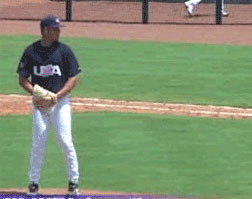 I also recommend, when in the stretch, to start with your head and hips just inside your drive foot. Have your feet past shoulder width and your lift leg hip ready to fire to the target. This will help you get your lower half moving even faster to the target which will allow you to build maximum momentum along with optimal speed to hold base runners on.
It is important to remember that whatever you do to your delivery in the pitching windup vs stretch they must match each other once the hips begin moving towards the plate. If this does not occur then it will be very hard to stay consistent mechanically through the entire game. This will have a big effect on your balls to strikes ratio.
The #1 BioMechanics Velocity Training Program
 This program has helped tons of pitchers live the dream of throwing 90+mph and signing with a D1 University, getting drafted by a Major League Organization and making it back to Major League Baseball. Many scouts in all organizations of baseball have recommended this program to help young pitchers get to the 90+mph range to improve their value at the next level.
The reason the 3X Extreme Pitching Velocity Program works is because it is based off of science and it has been proven to develop the 90+mph fastball on thousands of pitchers. It isn't rocket science or voodoo, it is the real deal! The program comes with a high level workload of drills, lifts and exercises scientifically programmed to enhance throwing speed on the mound while developing an efficient pitching delivery. The format of the 3X Pitching Velocity Program is similar to the same approach Olympic throwers have been using for decades to increase throwing velocity. This approach isn't new to the sports world but it is new to baseball.
If you are serious about your career and are insanely driven to put yourself into an extremely small percentage of pitchers who are potential D1 prospects, top level draft picks or you just want to reach your potential on the mound then this program is the best chance you have to making your dreams come true.
Learn more about the 3X Extreme Pitching Velocity Program or get started TODAY adding 5-10+mph!


Brent-
Why is the full windup (the one that Feller, Dean, and many others used) destructive to velocity?
I am talking about the old school approach of using the windup strictly to swing and wip the arm to generate velocity as opposed to the 3X approach of relaxing the arm and using the stride phase to generate power and then converting that power through torque into the velocity of the ball.
Brent,
I have teaching that for years. That I believe the wind up actually serves no purpose outside of what you have stated above. When I train new pitcher's I only use the stretch, which is where you end up out of the wind up if your doing it right. In spring training that is all I used when working on my mechanics.
Minus the velocity you have lost in your bodies motion, of course….Why don’t starting pitchers use the stretch for over a century? Because it is inferior and you just need it to hold runners on.
Brent,
I think what we believe is basically the same thing. I misinterpreted what you were saying. I thought you were referring to the actual windup being destructive to velocity. Of course, the pitchers I used as examples were injury free and threw pretty hard. Most MLB pitchers for the last 110 years have used their whole bodies.
Sorry for my misinterpretation.
To avoid the windup is to entirely disregard Newton's First Law of Motion, where "motion" is crucial to a consistent delivery and to the development of velocity. Pitching is a fluid, athletic activity, and should be accomplished via a fluid, athletic motion. There are very few, if any, pitchers out there who can achieve windup velocity from the stretch. Let's ask Nolan Ryan about the importance of the windup.
The stretch is more a consistent delivery than the windup. Nolan Ryan, Dontrell Willis, all big leg lift guys who threw just as hard in the stretch. Power pitching has more to do with Newton's second and third laws of motion.
Just as hard, but as consistent? No, it is far inferior. Otherwise, why 2 types if deliveries? I trust over a century of professional starting pitchers who have a choice and almost exclusively start from the wind up? It is easier. You have more vision, and you have more of velocity and I’d bet your whole body is in fact descending faster…but that is just a guess. I know I threw 10% harder and 20% more accurately from the windup, yet I practiced the stretch more. Interesting topic.
Good Point, Brent. Newton's second law indicates that the force that is loaded up in the backwards movement of the windup is translated to the forward part of the pitching motion, an equal and opposite force. That force, when transferred properly to the pitching arm and hand, should equal the loaded force on the back step and transfer of weight to the back foot. I'm speaking here of a simple, linear backward step which is then pushed off, transferred to the rubber foot in a straight line to the plate, rather than a pivot, kick, etc. This is the way I teach throwing and pitching–back and forth, like the golf swing of Bobby Jones or Mike Austin. The weight is loaded up on the back foot and then transferred in a straight line to plate, the result is a highly consistent, higher velocity, fluid-motion pitch utilizing the entire body rather than just the arm. Better for kids, IMHO. Thanks for your comments.
I like what you are trying to do here but I don't see how this delivery transfers to the stretch or how this delivery creates more hip to shoulder separation at front foot strike. Do you believe that hip to shoulder separation is a major component to velocity?
Not in this instance. The linear nature of the pitching move removes almost any pivot, which places a great amount of stress on the joints of young arms. This movement is straight back and nearly straight forward, with the pitcher's chest facing the plate all the time, and the shoulders are almost square to the plate as well. Again,, I'm talking about a manner in which we teach little leaguers the fluidity of the windup–the athleticism of pitching, IMHO–while getting them to understand the concept of a)loading up and release, and b)the focus of driving "downhill" on the pitching motion. Hip shoulder separation is a component to velocity, it has to be, since it is the equivalent of loading up the right side (of a right handed pitcher),and release. However, I still maintain that the fluidity of the windup does load up the backstep as well as "prep" the joints of the body, sheds stress from the body therefore increasing flexibility. Translation, in my opinion, is in greater velocity. Thank you again.
when working with my son and other pitchers, i noticed that the full windup did nothing for velocity. i use a radar gun to show pitchers how different phases of pitching add more velocity, and every time i get them to a full windup we not only don't see more velocity…sometimes they lose speed!
i say pitch from the stretch and get everything going towards the target and you will be more consistent and see good velocity.
I use a similar approach in my 3X Pitching Velocity program to teach triple extension and external rotation of the throwing arm but my pitchers throw 5-10 mph harder when they close the shoulders into front foot strike and focus on more back hip to back shoulder separation.
what’s the name on the guy that wrote this?
I wrote it Drew. Is that what you are asking?
Wow, never read such uninformed information. Not only does a complete full windup help prevent the shoulder and elbow issues created by the Yankee no windup approach. But velocity is significantly improved. The lack of velocity increase you are seeing is most likely a case of not understanding how to teach the full windup but also the simple fact of the pitcher not being comfortable with it. Worry less about pitch counts and more about the no wind up pitching style. As the chems for recovery start leaving baseball you will see a return to the full windup.
If this information is so uninformed then where is your case study or studies proving your claims about the wind-up? Practice what you preach.
Nolan Ryan used the correct full windup in my opinion. The act of bringing both hands behind his neck added to the backward momentum and then when reversed by hip rotation and the leg push against the rubber created more velocity. At the full height of the pitcher’s leg lift from the stretch, he can stop and maintain a balance. If you are using proper mechanics from the windup, there is no stopping because momentum from the rear is forcing that raised leg to go forward. It is called inertia. Look at shot putters – Discus throwing – javelin etc. and you will see that they all employ an initial backward motion to gain the maximum forward momentum. Since most pitchers today do not use this technique, there is virtually no difference between their bastardized windup and the stretch. If what you contend ( there is no speed difference between the windup and stretch ) then why would ANY professional pitcher use a windup ? Why learn 2 different methods of delivering the ball if there was no benefit to the windup ? Go tell an NBA player to use different mechanics when shooting a free throw depending on whether it is the first half or second half of the game and see what they have to say to you. The fact is that a proper full windup will give you added velocity. Just ask Nolan Ryan…
Pat, the basketball player does not shoot a free throw sideways like the pitcher in the stretch. Pitchers prefer the windup because they like to face the target before delivering the pitch. No studies show that velocity increases in the windup as opposed to the stretch so you are just talking.
Where did you get your video clip of John Smoltz? Thanks.
The velocity difference was actually faster in the full windup by 0.2m/s so yes there is a difference. Also this study was done on fully developed pros, whereas an adolescent can benefit from the added momentum much greater than a pro. Nolan Ryan averaged 127 pitches a game and even threw as high as 164 a game. 7 no hitters and all time strikeout leader, watching his windup it is clear to see how it can be an advantage. Not to mention if he could be clocked by today’s standards he would have hit 108mph. Just unreal. I think ultimately it comes down to comfort for the pitcher. If it works for you then go for it. I just know for 4 generations of pitchers in my family the windup has brought no hitters, immaculate innings, perfect games and all around success.
Having pitched a long time, can you tell me any starting pitcher that starts from the stretch? Maybe a few. Why would that be? There is a good reason: You lose vision and velocity, and there is no arguing that. I always teach kids to start from the wind up. Why not? It is more effective.
Survey the best pictures and do what they do (… It’s the stretch by the way)…