Top 10 Pitching Secrets to Prevent Injury
December 11, 2011
Pitching velocity secrets are in a lot higher demand than secrets to preventing injury. The deal is they should both go hand and hand. Who wants to increase velocity at a higher risk of injury? This is the problem with most pitching velocity tips is that they come with a price. I developed 3X Pitching with both pitching velocity and injury prevention as top priorities.
Let’s face it, throwing the ball at your top velocity is risky but so is returning punts in the NFL. If we are going to enhance our ability while promoting a long and healthy career, we must understand how our bodies work and how to prevent injury. The American Sports Medicine Institute has already informed the public that pitching injuries spawn from three main factors; Overuse, Poor Physical Fitness and Poor Mechanics. To take this information further, I will list here the top 10 pitching secrets to prevent injury in order from the most significant to the least but still significant. Read more
3X Pitching Superior to Extreme Long Toss
May 21, 2011
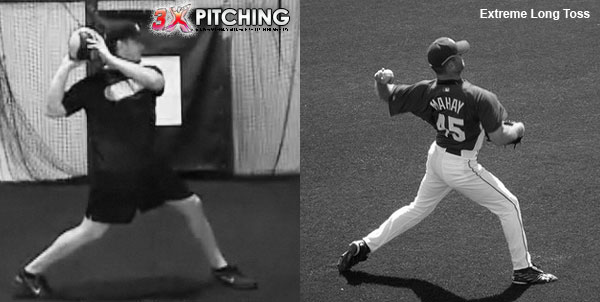
The argument behind extreme long toss is that the pitcher will learn how to take the velocity of a 300 foot throw and transfer it into a 60 foot throw. This is what I learned from watching an interview with Alan Jaeger who uses extreme long toss with yoga to develop pitchers.
If you have been following this site then you know that I am totally against this approach to pitching. Here is a quick summary of why I am against this type of training. The American Sports Medicine Institute (ASMI) proves in their latest case study here that this type of long toss creates elbow varus torque in the arm and uses different mechanics than those used on the mound. In defence, Alan Jaeger says that the athletics of the 300 foot throw when restricted to 60 feet, through his “Pull Down” phase, forces the pitcher to be more open and explosive. Read more
Comparison of High Velocity and Low Velocity Pitch Deliveries
June 18, 2009
Stodden DF, Fleisig GS, McLean SP, Lyman SL, Andrews JR. Relationship of pelvis and upper torso kinematics to pitched baseball velocity. Journal of Applied Biomechanics 17(2):164-172, 2001.
Matsuo T, Escamilla RF, Fleisig GS, Barrentine SW, Andrews JF. Comparison of kinematic and temporal parameters between different pitch velocity groups. Journal of Applied Biomechanics 17(1): 1-13, 2001.
Stodden, DF, Fleisig, GS, McLean, SP, Andrews, JR. Relationship of Biomechanical Factors to Basebal Pitching Velocity: Within Pitcher Variation. Journal of Applied Biomechanics 21(1): 44-56, 2005 Read more
Does Velocity Come from the Arm or the Body?
April 16, 2009
The arm throws the ball but does it generate the velocity in a 90+ mph fastball?
This question can stir up a big argument but there is only one answer. The arm does not generate the velocity. It only guides the pitch. Therefore the arm must follow the body and does not come into play until the body has done its job. Read more
Baseball Pitching Workout – Beginner
December 9, 2008
This is an excellent beginner workout. It focuses on training the body as a single unit. All these lifts support the development of Fast Twitch Muscle Fibers which will make you more explosive as an athlete. This workout was developed for pitchers but recommend for all positions. When starting this beginner program for the first time, make sure you keep your lifting weight down. Use the bar to start and once you gain confidence in your lifts, you can begin to add weight and use the percentages listed. Select the images below the workout of the lifts to view the instructional video. You can also view the Coach Gayle Hatch instructional videos here: Coach Hatch Videos to learn the lifts. Coach Gayle Hatch is a legend in the sports training world. He is most know as the 2004 USA Olympic Lifting Coach and was just named the World Coach for 2009. Some of the lifts do not have instructional videos. Search the web for exercises that would fill the role. Read more