

Sequential Rotation in the Pitching Delivery
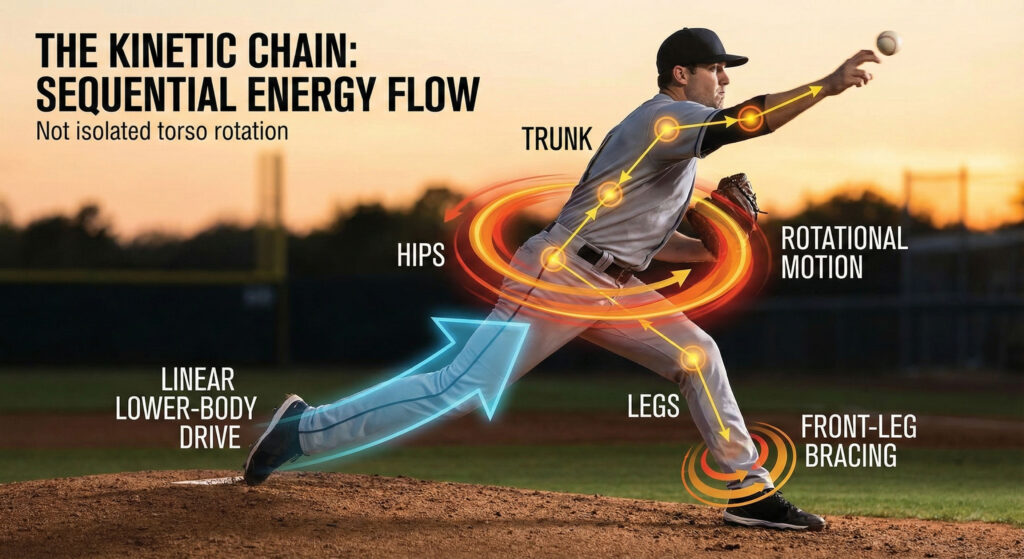
Pitching a baseball is often described as a rotational movement, but biomechanical evidence shows it is powered by a linear drive that transitions into rotation via the kinetic chain. The motion begins with the lower body: the back leg pushes against the ground to create linear momentum, and the front leg then braces to convert that forward momentum into rotational motion of the hips and trunk[1][2]. In other words, the pitcher drives forward off the rubber and, as the stride foot plants, that linear energy is redirected into an explosive rotation of the pelvis and trunk. Research on ground reaction forces confirms this sequence: propulsive force from the back leg contributes to energy flow into the pelvis and trunk, while the front leg’s braking force helps generate the trunk’s rotation that is ultimately transferred through the shoulder and arm[1][2]. This is a classic example of the kinetic chain or summation-of-speed principle, where energy flows from the large, powerful proximal segments (legs and hips) through the core to the smaller distal segments (arm and hand)[3][4].
Notably, elite pitchers do not simply spin in place – they combine linear and rotational components. A well-timed stride (linear) and rotation are both crucial. In fact, studies estimate that the lower body stride and trunk rotation together account for roughly half of a pitch’s velocity, with the rest coming from the arm’s rapid motion[5]. This underlines that high velocity pitching is not achieved by just arm strength or just twisting the torso, but by coordinating a powerful forward drive with a rapid rotational unwinding of the body. The legs provide the foundation: as one analysis puts it, the lead leg must “have a firm plant on the mound to give the hips and pelvis (and subsequently the shoulders) a solid foundation to rotate on”. Overall, the pitching delivery is a full-body movement in which rotation is generated as the product of strong linear forces and stable leverage against the ground.
Hip–Shoulder Separation and Trunk Rotation Mechanics
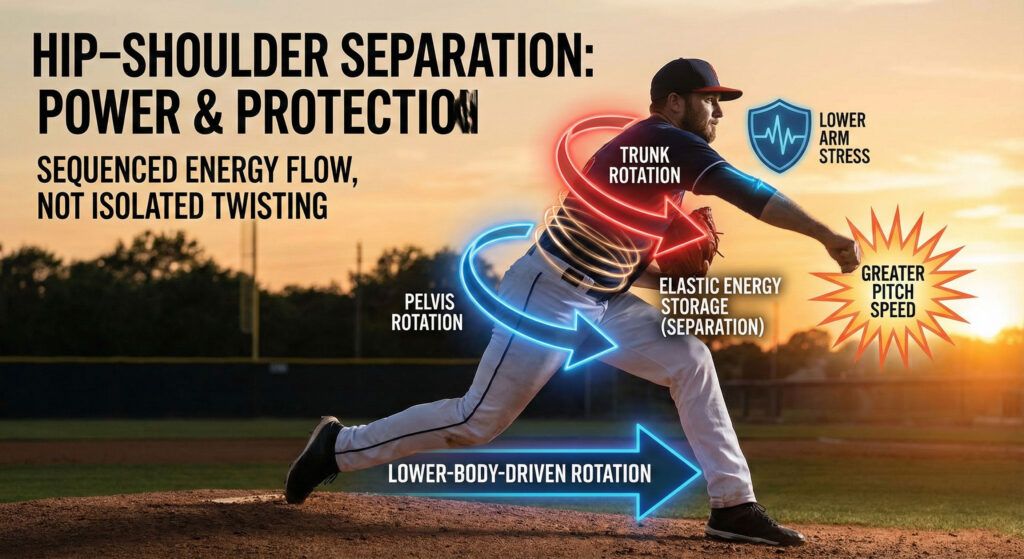
A key biomechanical factor in how rotation is utilized is hip–shoulder separation – the angular difference between the rotating hips/pelvis and the still-closed shoulders/torso during the stride and cocking phases. High-level pitchers excel at creating this separation: as the hips begin to rotate open toward the target, they keep their upper body closed longer, effectively twisting the torso against the hips like a coiled spring[7][8]. This stores elastic energy in the core musculature. Research shows that as the pelvis rotates ahead, the abdominal oblique muscles are put on an eccentric stretch, and then they contract powerfully to pull the trunk around once the stride foot lands[9]. In essence, the trunk’s rotation in pitching is not purely a concentric “twist” from a static start – it’s an explosive release of stored energy: the hips initiate rotation and the torso initially resists (an anti-rotation action) creating a stretch, followed by a rapid concentric firing of the trunk muscles to catch up. This sequence produces very high trunk angular velocity.
Hip–shoulder separation is often considered the “X-factor” for velocity. By delaying trunk rotation until after the pelvis has rotated (i.e. “stay closed” with the shoulders while the hips open), pitchers achieve greater torso stretch and subsequently higher rotational speeds. Studies in collegiate and pro pitchers find that those who achieve larger hip–torso separation tend to generate higher peak trunk rotation velocities and higher pitch speeds[10][11]. One recent biomechanical study confirmed that peak trunk rotational velocity is a strong predictor of ball velocity (explaining about 25% of the variance in pitch speed)[11]. Importantly, hip–shoulder separation is a contributor to that trunk speed: pitchers with more separation at foot plant and a well-timed sequence tend to achieve greater trunk rotational power[12]. In fact, an analysis of 29 young pitchers showed that a combination of higher peak pelvis rotation speed, greater hip–shoulder separation, and good timing explained over half of the variability in trunk rotation velocity between athletes[12][13]. This highlights that efficient rotation comes from proper sequencing – the pelvis rotation feeds into trunk rotation when separation is maximized at the right moment.
Another benefit of this delayed rotation is reduced arm stress. By letting the big muscles of the hips and core do more work (via that stretch–shortening rotation), the arm and shoulder don’t have to generate as much force on their own. It’s been observed that professional pitchers not only throw harder than amateurs, but often do so with less relative stress on the elbow and shoulder because their mechanics are more efficient in transferring energy[14]. For example, one study found that high-school pitchers experienced greater elbow torques (normalized to body size) than professional pitchers, even though the pros threw faster[14]. The likely reason is that the amateurs “opened up” early or didn’t generate as much separation, forcing the arm to compensate. When trunk rotation occurs too early (insufficient separation) – a flaw coaches call “opening up too soon” – potential energy is lost and velocity suffers, while the shoulder/elbow experience higher loading[15][14]. Thus, the role of rotation in pitching is to serve as the critical link in the kinetic chain, transferring and amplifying the lower-body power – but it must be properly timed and mostly powered by the lower body and core, not just the arm.
The Primacy of Rotation (and How It’s Achieved)

Although linear momentum is the trigger, rotational power of the trunk is one of the most vital contributors to pitch velocity. A segmental power analysis by Aguinaldo et al. found that the mechanical power generated by trunk rotation during the delivery was the single strongest predictor of ball speed[16]. In fact, trunk rotation power was identified as having the greatest influence on velocity among body segments, reinforcing that a pitcher’s ability to explosively rotate the torso (after that initial linear drive) is what really puts speed on the ball[16][17]. High-velocity pitchers universally exhibit rapid pelvis and trunk rotation; they typically rotate their hips and trunk faster than their lower-velocity peers, which allows more energy to be passed on to the throwing arm[10].
However, it’s crucial to understand how that rotation is produced. It is not by simply swiveling the torso using only the obliques or other trunk muscles in isolation – it’s a coordinated, ground-up action. The legs and hips generate momentum and initiate rotation, the core muscles control and channel that rotation (often by resisting then releasing as described above), and then the upper body and arm follow through. This is why training purely “rotational strength” (e.g. endless Russian twists or using devices that just make you turn back and forth) without context may be an oversimplification. Pitching rotation is a dynamic, multiplanar action – involving the sagittal plane drive, frontal plane bracing, and transverse plane twisting – not rotation alone. For instance, a strong linear stride is needed to effectively use rotational core strength; if a pitcher just spins their trunk without a good stride, it’s like rotating with no power behind it. Conversely, a powerful leg drive without good trunk rotation timing wastes energy. Thus, both elements work in tandem. Studies have even manipulated stride length to examine this balance: a shorter-than-optimal stride gives the pitcher less time and space to develop separation, causing the trunk to rotate too early and rely more on late torso twisting – which can increase stress on the arm as it “plays catch-up”[18][19]. The optimal technique finds the right blend of linear and rotational mechanics.
To sum up the biomechanics: rotation in the pitching delivery emerges from well-sequenced interactions of the legs, hips, and trunk, rather than from simply torquing the torso by itself. The best pitchers create rotation through ground reaction forces and leverage: the back leg drives the body forward, the lead leg then braces to stop forward movement, and this sudden braking causes the torso to whip around. The core musculature (glutes, obliques, etc.) mostly acts to stabilize and transmit forces in the split-second when the hips fire and the shoulders lag behind. Only after that elastic loading do the trunk muscles concentrically contract to complete the rotation and accelerate the arm[9]. So the essence of rotation in pitching is largely about storing and releasing rotational energy (through hip–shoulder separation and a strong core) rather than continuously muscling through a twist.
Training Implications: Developing Functional Rotation Power
Given the above, the best way to train for pitching power is not to simply over-emphasize isolated rotational exercises, but to train the entire kinetic chain to produce and transfer force efficiently. Key evidence-backed approaches include:
- Develop Lower-Body Force and Stability: Since the legs initiate the pitching movement, exercises that build a powerful drive off the back leg and a solid front-leg brace are crucial. Coaches and research emphasize closed-chain lower-body exercises – squats, deadlifts, lunges, single-leg presses – which strengthen the hips, glutes, and legs in a way that translates to pushing against the ground[20]. A strong lower half provides the “platform” from which the trunk can rotate explosively. Additionally, exercises that train front-leg stability (such as single-leg landing drills or lunge variations) can help a pitcher better brace and transmit force upward during the stride plant. Remember, the front leg’s firm plant is what allows the hips and trunk to whip around rapidly[6]. Without good strength and balance in the lead leg, a pitcher may leak energy or rotate too slowly.
- Enhance Hip–Shoulder Separation Ability: This means working on both mobility and core stability. Adequate hip and thoracic spine mobility is needed to achieve the twisted “separation” position – for example, drills to improve thoracic rotation flexibility can help a pitcher rotate the shoulders independent of the hips. But just as importantly, the athlete needs the core strength and motor control to hold the trunk back while the hips open. Anti-rotation core training is extremely valuable here. These are exercises where the core must resist being twisted – e.g. Pallof presses, cable anti-rotation holds, plank variations – which build the stability to control rotation. By training anti-rotation, pitchers learn to “keep their trunk closed while the lower half rotates”, improving that critical dissociation between hip turn and shoulder turn. In effect, a robust core that can stiffen eccentrically against rotation allows for a bigger stretch (and later a more explosive recoil). Coaches often note that lacking this stability leads to what some call “fake separation,” where a pitcher compensates by twisting through the lower back instead of truly separating hips and shoulders. Proper core training helps avoid that, ensuring the rotation comes through the athletic midsection (hips and thoracic spine) rather than the lumbar spine. It also prepares the body to decelerate rotation safely – an often overlooked aspect. The obliques and other core muscles must powerfully slow down the torso after ball release to protect the spine and shoulder; it’s no coincidence that oblique strains are common in pitchers who can’t adequately control that deceleration. Anti-rotation and eccentric core work directly address this need.
- Train Integrated Rotational Power (Not Just Twisting in Isolation): To improve the concentric rotational force of the trunk in a pitching-like manner, medicine ball throws and rotational plyometrics are popular and supported by principles of specificity. For example, a pitcher might perform a step-behind rotational medicine ball throw against a wall – this drill mimics the pitching sequence by using a stride and hip rotation to sling the ball, enforcing that the legs and core work together to generate rotational power. Such exercises teach the body to coordinate the hip drive with a rapid trunk turn and a forceful arm movement, bridging the gap between raw strength and pitching skill. They also inherently train timing – you have to sequence the movement correctly to get a powerful throw, much like pitching. This kind of proximal-to-distal power development is far more applicable than, say, standing in one place twisting with a bar across your shoulders. Indeed, a recent study in Journal of Strength & Conditioning Research concluded that “training to improve pelvis–trunk axial dissociation may increase maximal trunk rotation velocity and thereby increase ball velocity without increasing stress on the arm”[13]. In practical terms, this could include targeted mobility/stability work (as noted above) combined with explosive rotational exercises that reinforce the hips-leading, torso-following pattern. Even traditional strength exercises can be tweaked for rotational athletes – e.g. doing split-stance cable presses or landmine rotations that engage the legs and core together. The main idea is to strengthen the link between lower-body drive and trunk rotation.
- Ensure Adequate Eccentric Strength and Deceleration Training: Pitchers need to be able not only to accelerate rotationally but also to decelerate safely to avoid injury and efficiently end the kinetic chain. Exercises that emphasize catching or stopping rotation can be useful. For instance, some trainers use medicine ball catch-and-stop drills (where the athlete catches a rotating med ball and halts the motion), or they incorporate eccentric overload in rotational movements (one benefit sometimes cited for water-filled implements, discussed below). The rationale is to fortify the muscles that brake rotation (obliques, para-spinals, etc.), which can enhance control and potentially allow the pitcher to apply force later in the delivery without fear of being unable to control it.
In summary, the best training approach is multi-faceted: build leg drive, develop core stability (anti-rotation and anti-extension strength), improve mobility for separation, and practice explosive rotations in a pitching-like fashion. This holistic method targets the true sources of pitching power. It’s in line with the idea of training movements, not just muscles – the goal is to enhance the kinetic flow of energy from the ground up, rather than just making the torso “strong” in isolation.
Overvaluing Rotational Gadgets: Are We Spinning Our Wheels?
With the growing focus on rotational power, many coaches have introduced specialized devices like water-filled bags, balance tubes, or long flexible bars to challenge an athlete’s rotation. The theory is that the sloshing water or unstable resistance forces the athlete’s core to engage more and thus improves rotational strength and stability. However, it’s important to scrutinize the evidence (or lack thereof) behind these methods. As of now, there is no solid peer-reviewed research showing that training with waterbags or similar unstable implements leads to better pitching performance or reduced injury risk[25]. The purported benefits – e.g. increased core muscle activation, better balance – remain speculative when translated to a high-speed skill like pitching[25].
In fact, experts caution that excessive focus on instability and chaotic rotation can be counterproductive for skilled motor patterns. Pitching is an extremely fast, refined movement that relies on precise sequencing and timing. Introducing a lot of random perturbation (like a waterbag’s unpredictable slosh) during training might “overload” the nervous system in the wrong way. Instead of refining the pitching sequence, the athlete is busy reacting to the moving water to avoid losing balance[26]. Research in motor learning suggests that too much random variability can degrade the execution of a complex skill – essentially, the body starts focusing on managing the instability rather than optimizing the throwing mechanics[26]. One analysis noted that with a highly unstable load, the central nervous system may prioritize “reactive stabilization over refining motor patterns,” potentially leading to altered or less efficient technique[27]. In other words, a drill that is overly chaotic might teach the pitcher’s body habits that conflict with the smooth, repeatable pitching motion.
Another point of concern is that instability tools can encourage inappropriate muscle firing patterns. For example, to control a sloshing bag, an athlete might stiffen up the core and reduce trunk motion – which is the opposite of the fluid but explosive rotation we want in pitching. As a 2016 review on pitching mechanics noted, proper rotation involves a balance of mobility and stability; too much rigidity can actually increase joint stress (e.g. a rigid torso might make the shoulder work harder)[28]. If a training tool causes the pitcher to become overly stiff or use odd compensatory movements to “fight” the instability, it could be reinforcing the wrong neuromuscular patterns for throwing[28].
There’s also the issue of efficiency: managing a sloshy weight is metabolically and neurologically demanding, but not necessarily in a productive way for pitchers[29]. One detailed critique pointed out that while unstable-load training can improve balance in general, its transfer to throwing velocity is questionable – the athlete might expend a lot of effort stabilizing that doesn’t translate into added force on the ball[30]. In high-level pitching, small losses in efficiency or timing (measured in milliseconds) can make a big difference. If a training modality saps some of the athlete’s explosive focus or alters their timing, the cost/benefit ratio may be poor for the specific goal of improving pitching[30]. As the analysis summarized, for rehabilitation or general fitness, instability devices have their place, but for elite pitching performance their benefit is low and the potential disruption high[30][31].
Waterbag-style drills do have one plausible benefit: they can train the core to decelerate rotation, because the moving water creates sudden momentum changes that the athlete must resist to stop the bag’s motion. In a controlled way, this could mimic the eccentric demands of pitching deceleration. However, the key is dosage and context. Integrating a few such drills as supplemental work (for example, as a warm-up or a core challenge) can be reasonable for variety and for engaging stabilizer muscles. But overtraining rotation via these unconventional tools – making it the centerpiece of a pitching program – is likely misguided. It might even work against the natural kinetic flow by introducing too much chaos and preventing the pitcher from ingraining a consistent, powerful delivery. The consensus among many sports scientists is that you should first master and strengthen the fundamental mechanics (which are largely stable, powerful movements), and only use unstable/novel training methods sparingly to address specific needs.
In practical terms: a few sets of rotational throws with a water-filled tube won’t magically add MPH to your fastball, especially if not accompanied by improvements in how you sequence your body. And if a young pitcher spends most of his training time standing on wobble boards or twisting with a slosh pipe, he may develop great balance but still lack the ability to generate force where it counts. As the evidence stands, traditional strength and conditioning paired with skill-specific explosive work holds far more proven benefit for pitchers than high-tech gadgets promising “rotational strength.” No device can replace sound mechanics and a strong, well-coordinated kinetic chain.
Conclusion: The Truth About Rotation in Pitching
Rotation in pitching is both critical and complex. It’s not a single muscle action but the culmination of a well-timed sequence starting from the ground. The best pitchers harness linear forces (from the legs) and convert them into rotational energy (in the hips and trunk) with minimal loss. Rotation is generated through a mix of anti-rotation (stability) and explosive uncoiling, rather than continuous twisting effort. This means that to enhance pitching performance, one should train the legs to be strong and explosive, train the core to be stable (able to resist and then unleash rotation), and practice the coordinated rotational movements that mirror the pitching motion. Peer-reviewed evidence suggests that improving how the pelvis and trunk work together – in timing, mobility, and power – can increase pitch velocity without adding stress to the arm[13]. On the other hand, over-emphasizing simplistic rotational drills or fancy instability gadgets can be a dead end, or even detrimental, if they don’t integrate with the pitching sequence or if they disrupt the athlete’s mechanics.
In summary, pitching isn’t purely about how fast you can twist your torso – it’s about how well you can generate force with your whole body and channel it into a rotational throw. Rotation plays a pivotal role in that kinetic chain, but it must be trained in context. The latest sports science supports a balanced approach: build a strong base, cultivate the mobility and core control for hip–shoulder separation, train explosive rotation in functional ways, and be cautious of training methods that sound impressive but lack evidence. By doing so, pitchers can maximize the beneficial rotational forces in their delivery while preserving the efficiency and rhythm that make high-level pitching possible.
Sources:
- Howenstein et al., Biomech. (2020) – Ground reaction forces and energy flow in pitching[1][2]
- Jump et al., Biomech. (2026) – Hip–shoulder separation and velocity in college pitchers[9]
- Orishimo et al., J Strength Cond Res (2023) – Pelvis/trunk rotation velocity and pitch speed[11][13]
- Aguinaldo & Escamilla (2019) – Segmental power analysis in pitching (conference abstract)[16]
- STL Physical Therapy (Ed Pilgrim, 2022) – Blog on hip–shoulder separation and pitching mechanics[8][14]
- Motor Preferences Experts (Genest, 2025) – “The Waterbag Illusion,” analysis of unstable rotation training in baseball[25][26][30]
[1] [2] Peak horizontal ground reaction forces and impulse correlate with segmental energy flow in youth baseball pitchers - PubMed
https://pubmed.ncbi.nlm.nih.gov/32635991/
[3] [4] [7] [8] [10] [14] [15] What is Hip Shoulder Separation?
https://www.stlphysicaltherapy.com/post/what-is-hip-shoulder-separation
[5] Effect of Clubbell Training on Glenohumeral Internal and External Rotation, Muscle Function, and Ball Velocity in Baseball Pitchers
https://www.ajkinesiol.org/journal/view.php?doi=10.15758/ajk.2022.24.2.19
[9] Influence of Hip-Shoulder separation on pitch velocity in college baseball pitchers - ScienceDirect
https://www.sciencedirect.com/science/article/abs/pii/S0021929025006293
[11] [12] [13] Role of Pelvis and Trunk Biomechanics in Generating Ball Velocity in Baseball Pitching - PubMed
https://pubmed.ncbi.nlm.nih.gov/35836313/
[16] [17] A FICTITIOUS STUDY ON HOW TO HAVE YOUR ISBS 200X PAPER ACCEPTED
https://sprinz.aut.ac.nz/__data/assets/pdf_file/0014/203135/240_1463_Aguinaldo.pdf
[18] [19] Influence of Stride Length on Pelvic–Trunk Separation and Proximal Plyometrics in Baseball Pitching
https://www.mdpi.com/2075-1729/15/9/1440/pdf?version=1758074356
[25] [26] [27] [28] [29] [30] [31] Are Waterbags Effective for Baseball Throwing?
https://motorpreferencesexperts.com/blog/baseball-2/the-waterbag-illusion-46