

How fast can the average person throw a baseball? A useful answer needs a defined age group, throwing experience and test method. This article does not establish a research-backed average for the general population. An untrained adult, a youth player and a trained pitcher are different comparison groups. A mound pitch and a running throw are different tests.
If you want to know how your own throw compares, first record it consistently. Then use a benchmark that identifies who was measured and how—not an unexplained internet range.
How to measure your speed · Choose a useful comparison · Common questions
What Does “Average Throwing Speed” Actually Mean?
An average describes a particular sample, not every person. Before treating a number as a benchmark, look for the participants' ages, experience, number tested, ball type, throwing task and measurement method. Also check whether the result is each person's fastest throw, an average across repeated throws or an average across people.
A study of trained baseball throwers cannot, by itself, establish what an untrained adult typically throws. For example, Roach and colleagues' 2013 throwing-biomechanics study tested 20 male subjects with substantial throwing experience. It investigated throwing mechanics; it was not a representative survey of the general population. The authors' paper and methods explain that sample and test.
Editorial clarification, September 14, 2026: Earlier untrained-adult speed ranges have been removed because the original article did not provide a supporting dataset or testing protocol. They should not be treated as validated population averages.
Choose the Right Comparison for Your Result
- New or recreational thrower: Start with a repeatable personal baseline. A professional pitcher's speed is not a useful starting requirement.
- Youth player: Compare players of similar age and experience using the same pitch type and testing setup. Our pitching velocity by age guide provides context and explains why charts are not individual development guarantees.
- Trained pitcher: Compare the same pitch type, delivery and measurement method across sessions. Keep maximum velocity separate from the range you can repeat.
- Position player: Label whether the result came from a standing throw, crow hop or running approach. Do not silently compare it with a mound-pitch result.
A number alone cannot tell you whether someone is above average, ready for a particular league or certain to reach a future velocity. Those conclusions require an appropriate comparison group and additional information.
How to Measure Your Baseball Throwing Speed
- Define the task before recording. Note the ball used, mound or flat ground, distance, pitch or throw type, and whether a step or run-up is allowed. Keep those conditions consistent when comparing sessions.
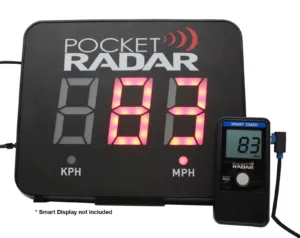
- Use equipment designed for ball-speed measurement. Follow its setup instructions and use a protected testing area. Radar alignment matters: Pocket Radar explains that Doppler measurement works near the ball's line of travel. Its setup guidance explains why off-angle readings can be lower.
- Keep a record, not just a best number. Record valid readings and the conditions under which they were taken. Label the session maximum separately from its typical readings. A single unusual reading should not become your benchmark without checking the setup.
- Compare like with like. Keep device placement and the measured part of ball flight consistent. Do not combine a radar peak with an average speed calculated over the whole flight and call them the same measurement.
For distance-and-time calculations, use our pitching velocity calculator guide. If you are comparing different throwing distances, the pitch-speed conversion chart explains equivalent flight time; its numbers are not your measured throwing velocity.
Throwing Velocity Influencing Factors

Throwing is a coordinated movement, not just a test of arm strength. The Roach study describes energy transfer across body segments and elastic energy storage at the shoulder. That helps explain why a strength result alone is not a direct prediction of ball speed.
For a development review, consider throwing experience, delivery coordination, physical preparation, current workload and the testing conditions together. A coach can use those observations to choose training priorities. This is not a promise that one mechanical change, stretch or lifting exercise will produce a specific velocity gain.
For background on TopVelocity's training approach, see the 3X Pitching Velocity Program overview.
Throwing Speed Improvement: Start With a Baseline

First decide what you want to improve: a repeatable pitch, throwing accuracy, position-player throws or general skill. Record a baseline for that task, select an appropriate training plan, and compare follow-up measurements under the same conditions.
Do not choose a workload or weighted-ball routine from a generic “average speed” article. Training needs to fit the player's experience and current condition. Youth pitchers should use MLB Pitch Smart's age-specific pitch-count and rest guidance.
Progress is individual. This article does not establish a guaranteed mph gain or a timetable for improvement. Use changes in repeatable measurements and task performance to judge progress, rather than assuming a higher isolated reading proves that a program worked.
FAQs: How Fast Can the Average Person Throw a Baseball?
Can a person's throwing speed improve with age?
Age alone does not guarantee improvement. Interpret a player's measurements alongside experience, training and the test used. This article does not establish a universal age-to-speed progression or an expected gain for every adult.
Are there specific drills that improve throwing speed?
Drills should address an identified need in the player's delivery or preparation. A list of long-toss or weighted-ball exercises is not a suitable universal prescription for an untrained reader. Choose the task and progression with a qualified coach rather than copying a routine based only on a desired mph number.
Can women throw as hard as men?
A person's sex does not tell you their measured throwing speed. To compare groups responsibly, you need matched ages, experience and testing conditions. The sources used here do not establish general-population averages for that comparison; measure the individual rather than assigning a speed from a label.
Is throwing technique important in determining throwing speed?
The biomechanics research linked above supports the role of coordinated movement and energy transfer in throwing. It does not mean there is one identical delivery for everyone or that copying a professional guarantees the same speed.
What common mistakes should I avoid when measuring progress?
Avoid changing the device setup, comparing a running throw with a mound pitch, mixing peak and average speeds, or using an unexplained benchmark. Keep training workload and rest separate from the urge to set a new radar maximum.
How long does it take for throwing speed to improve?
There is no timetable established here for an individual. Record your starting point and repeat the same assessment as part of your training plan. Do not treat “weeks or months” as a promise of a particular result.
Ready to Turn Your Baseline Into a Training Plan?
For pitching development, start by comparing the current in-person and online 3X Velocity Camp options, dates and included services.
Prefer app access without a camp? Review Player Platform plans and their current features before choosing.
Just researching your throwing speed? The measurement guidance and comparison links above are available without registering.


Trackbacks/Pingbacks