

If there’s one thing every baseball player hears, it’s the importance of training, nutrition, and sleep. This “big three” forms the foundation of performance. While endless hours are spent in the weight room and countless discussions center on diet, sleep often gets overlooked. Yet, for baseball athletes chasing velocity, recovery, and injury prevention, sleep is just as critical as any bullpen session or lift.
This article provides a practical overview of why sleep is essential in baseball—and how to maximize it for performance.
Why Sleep Matters in Baseball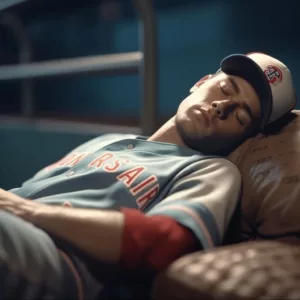
Because sleep deprivation makes almost everything worse—and it’s incredibly common. Many athletes don’t even realize they’re living in a constant state of sleep debt.
-
From a health perspective: Poor sleep increases inflammation, suppresses immunity, and elevates injury risk.
-
From a training standpoint: It reduces strength, slows recovery, and blunts adaptation from velocity and strength programs.
-
From a mental standpoint: It impairs mood, focus, reaction time, and decision-making—vital for hitters and pitchers.
📊 Study: Milewski et al. (2014, Journal of Pediatric Orthopaedics) found that high school athletes sleeping <8 hours per night were 1.7x more likely to suffer injuries compared to those getting 8+ hours.
For baseball players logging high throwing volumes, double-headers, and travel, cutting sleep magnifies fatigue and raises the odds of breakdown.
How Much Sleep Do Baseball Athletes Need?
There isn’t a single “magic number,” but the guideline is clear:
-
8–10 hours per night for athletes in training.
-
Pitchers and catchers, who endure the most repetitive stress, often need more during heavy workloads.
Many players claim to “function fine” on 6 hours—but research shows otherwise.
📊 Study: Van Dongen et al. (2003, Sleep) showed that participants restricted to 6 hours for 2 weeks performed as poorly on reaction tests as those who went 2 nights without sleep.
📊 Study: A 2025 paper in Frontiers in Neuroscience (“The Impact of Sleep Deprivation on Cognitive Function in Healthy Adults”) confirmed that even one night of poor sleep caused measurable delays in auditory P300 signals (markers of attention and decision-making) and an average reaction time slowdown of ~83 ms. Considering a 95-mph fastball reaches the plate in ~400 ms, that kind of lag could be the difference between a line drive and a swing-and-miss.
👉 A good test: if you wake up without an alarm and feel sharp at practice, you’re likely sleeping enough. If you rely on alarms and feel groggy, you’re probably in sleep debt.
Circadian Rhythm & Baseball Performance
Sleep is regulated by your circadian rhythm—your body’s internal clock. Consistency is critical: going to bed and waking up at the same time keeps this rhythm aligned.
Why does this matter in baseball?
-
Travel across time zones (common in pro/college ball) disrupts rhythm, hurting reaction time and decision-making.
📊 Study: Mah et al. (2011, Sleep) found that college basketball players who extended sleep improved sprint times, shooting accuracy, and overall performance. The same applies to hitters and pitchers—consistent, extended sleep sharpens game-day output.
Naps: A Secret Weapon in Baseball
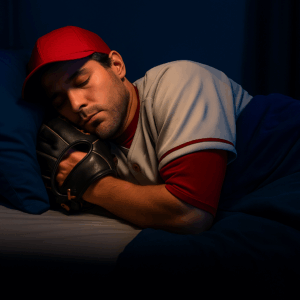
Tournament play, late nights, and travel create unavoidable fatigue. Used strategically, naps can restore alertness:
-
Best time: Early afternoon (post-lunch dip).
-
Best duration: 20–30 minutes (enough to recharge without grogginess).
📊 Study: Waterhouse et al. (2007, Journal of Sports Sciences) showed that a 30-minute nap improved sprint performance and alertness. For baseball, this can mean fresher legs in extra innings or sharper reactions late in a double-header.
The Role of a Night Routine
A pre-bed ritual helps signal to your body it’s time to shut down. For baseball athletes, that might include:
-
Post-game shower and stretching
-
Journaling practice notes or mental prep
-
Light reading or breathing exercises (instead of TikTok scrolling)
Consistency is key. Just like training, building a repeatable nighttime routine produces results.
Light, Electronics & Baseball Recovery
Blue light from screens delays melatonin, the hormone that triggers sleep. Even “watching film” late at night can cut into recovery.
📊 Study: Chang et al. (2015, PNAS) found that evening screen use delayed sleep onset and reduced REM sleep, impairing next-day alertness.
✅ Solution: Shut down screens 60–90 minutes before bed. Review film earlier, and use evenings for recovery routines.
✅ Morning sunlight (or light therapy boxes) helps reset circadian rhythm after travel or night games.
Substances & Timing
-
Caffeine: With a half-life of 5–6 hours, a late-afternoon coffee or energy drink can still be in your system at midnight. Cut caffeine 6–8 hours before bed.
-
Alcohol: May knock you out but wrecks REM sleep. (Roehrs & Roth, 2001, Alcohol Research & Health).
-
Late Workouts: Training helps sleep overall, but late-night intensity raises body temp and alertness. Aim to finish 3–6 hours before bedtime.
Optimizing Sleep Environment for Baseball Athletes
-
Darkness: Blackout curtains or a quality sleep mask.
-
Noise control: Earplugs or white noise—especially in dorms or hotels.
-
Cool room: 60–67°F is ideal for sleep efficiency.
📊 Study: Krauchi et al. (1999, American Journal of Physiology) showed that cooler environments improve sleep onset and quality.
Final Thoughts
For baseball athletes, sleep isn’t just “rest.” It’s the recovery system that locks in the gains from strength training, pitching drills, and nutrition. Without it, velocity plateaus, reaction times slow, and injury risk climbs.
Prioritize sleep just like your bullpens or lifts:
-
8–10 hours per night.
-
Stick to a consistent schedule.
-
Limit blue light, caffeine, and alcohol.
-
Optimize your environment.
The latest neuroscience confirms: even one night of poor sleep can measurably slow reaction time and focus. In a sport of milliseconds, that’s the difference between winning and losing.
Sleep is the missing link that turns hard work into performance on the mound and in the box.
Actual Final Thoughts on Sleep Optimization
I want you to understand, these are the suggestions based on the scientific evidence. Realistically though, not many players are going to have the ability to live up to these idealistic standards. But even just understanding and implementing a few of these recommendations can make or break your athletic performance. My recommendation. Start small, if for instance, if you have to do that late night studying and its solely on your phone or computer, look into getting some blue light blockers so you are at least taking in only a fraction of the amount of blue light.
If you are unsure about how to implement these methods and looking for step by step guidance on optimizing everything from pitching mechanics to sleep and nutrition then give us a call and we'll get you on the road to perfecting every aspect of your athletic career.