
Imagine your body is a high-end construction site. Usually, the crew is focused on general maintenance and upgrading the engine—your legs and core. But the moment you feel that "pop" in your elbow or a strain in your shoulder, an emergency repair alarm goes off.
The site shifts. All resources are diverted to the "Front Door"—your arm. But here is the problem: if you stop sending in the "bricks" (high-quality protein and amino acids) and the "fuel" (calories), the workers don't just stop. They start tearing down the Back Porch—your leg muscle—to get the materials they need to fix the arm.
By the time you're cleared to play, you have a shiny new front door, but your engine is gone. You’ve traded your 90 mph heater for a "healed" arm that no longer has the horsepower to support it. This is how the cycle of re-injury begins.
The Mental Shift: From "Broken" to "Project Manager"
When an athlete "checks out" mentally during an injury, they stop being the CEO of their own performance. They start viewing their body as a collection of isolated parts rather than a single, unified system. But your body doesn't work in silos.
If you allow the "demolition crew" of muscle wasting to take over your legs while you're focused solely on your arm, you aren't just losing muscle; you're losing your force production capacity. Recovery is not a pause button; it is a high-stakes management phase where your choices dictate the quality of your return to the mound.
The Force Production Connection: Why the Engine Must Stay Loud
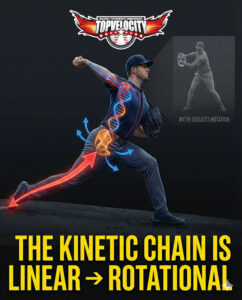
In baseball, velocity is a whole-body event. It starts with the ground, moves through the legs, is amplified by the core, and is finally delivered by the arm.
-
The Ground Force: Your legs are the primary power generators.
-
The Back Leg Powerhouse: The back leg initiates the movement, pushing energy into the hips and allowing for hip-shoulder separation. It is the anchor that allows you to load energy and create "stretch." For a more detailed break down of the back leg pitching mechanics check out my video "9 Power Pitching Points to 100mph"
-
The Oblique Sling: This separation maximizes the elastic energy stored in your obliques. When the back leg drives and the upper body stays back, you create a massive amount of tension—like pulling back a giant rubber band. This is the physiological foundation of the Stretch-Shortening Cycle, a process where your muscles rapidly load and contract to multiply force.
-
The Final Delivery: The arm is simply the "Whip" at the end of the chain.
If your "Engine" (the back leg and hips) loses power during your downtime, your brain will still try to demand 90 mph from a system that can now only safely produce 84 mph. To close that gap, your arm has to "redline." This overcompensation is exactly how the vicious cycle of re-injury begins.
The Hidden Muscle for Recovering Throwing Velocity
While most athletes obsess over the size of their quadriceps, the true predictor of lower-body power is often found deep beneath the surface in the soleus muscle. Often described as the "grip strength of the lower body," the soleus is a critical regulator of how much force your legs can actually express against the ground.
If your calves and ankles are unstable, your brain will physically "down-regulate" the power output of your quads and glutes to protect the joints. In other words, you can have a massive engine, but if your "tires" (the soleus and ankle complex) are bald, you’ll never get that power to the pavement.
Scientific research has identified the soleus as the primary driver of vertical and forward body center acceleration. According to research published in the Journal of Experimental Biology, the soleus generates upward accelerations equivalent to approximately 2.0 bodyweights of ground reaction force during high-speed movement (Hamner et al., 2010).
Furthermore, the soleus acts as the "dynamic stabilizer" of the lower limb. A study in The Journal of Applied Physiology highlights that a strong soleus is essential for controlling the forward motion of the shin bone (tibia). This control allows the quadriceps to fire more effectively, creating a stable platform for the back-leg drive that every pitcher requires (Dorn et al., 2012).
The Link Between the Soleus and Quad Power
Without a stable and powerful soleus, the "oblique sling" we discussed earlier cannot reach its full elastic potential. If the ankle collapses or the soleus fails to stabilize the lower leg during the drive phase, the kinetic energy "leaks" out of the bottom of the chain. This forces the upper body to compensate, leading directly back to the arm-centric trap and increased risk of injury.
Drive-Line Maintenance: Saving Your Engine
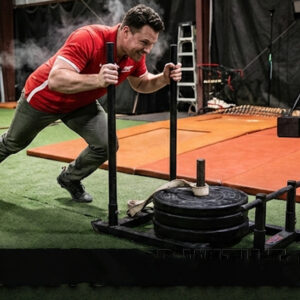
Just because your arm is in the shop doesn’t mean the rest of the car should sit in the garage. To maintain your back-leg drive and hip power, you must keep the engine running with movements that do not stress the injured limb.
-
Heavy Sled Pushes or Drags: This is the ultimate tool for preserving the engine. Driving the sled maintains the specific leg strength and drive mechanics needed to push off the rubber without putting an ounce of stress on a sensitive arm.
-
Safety Bar or Belt Squats: These allow for heavy loading of the lower body without needing to grip a traditional bar, protecting the shoulder and elbow while keeping the legs explosive.
-
Single-Leg Glute Bridges: These isolate the "power muscles" of the back leg, ensuring you don't lose the ability to stabilize and initiate force from the ground up.
Maximize Your Nutrition to Protect Your Gains
The most dangerous part of recovery isn't the injury itself—it's the rest periods in between. This is when the "Construction Site" is most active.
If you aren't hitting the higher end of the protein spectrum and supplementing with high-quality aminos, such as BodyHealth Perfect Amino, your body will view your downtime as an opportunity to raid your legs for resources. You might keep the movement patterns through training, but you will lose the "Premium Bricks" that make those movements explosive.
Come Back Stronger: Let Us Help You Lead the Way
At our camps and programs, we don't believe you have to be perfectly healthy to start improving. We specialize in injury prevention and recovery, helping athletes understand that the body is a unified system.
If you are struggling to come back from an injury, don't face the "demolition crew" alone. We can help you maximize every facet of your game—from the mental approach to physical health—to ensure you come back stronger and more explosive than before.
Contact us today to learn how our specialized training and nutrition protocols can protect your velocity and keep your engine running.