

A catcher pop time by age chart needs representative data. The cited sources do not establish an average for every birthday. For college prospects, NCSA's published targets include 1.95 seconds or faster for Division I and 2.10 or faster for junior college—not youth age averages. NCSA recruiting guidelines.
For a youth catcher, start with accurate, repeatable throws under consistent conditions. For a high school catcher exploring college baseball, use published recruiting targets as reference points, then evaluate the complete player. Neither comparison makes a single stopwatch result a verdict on your future.

What does catcher pop time measure?
Pop time includes both getting the ball out and its travel toward the base. TrackMan defines it from the catcher receiving the pitch until the throw crosses the target base's plane. Its exchange time runs from reception to release, not merely glove-to-hand transfer. TrackMan measurement glossary.
For matching endpoints on the same throw: pop time = exchange time + ball-flight time. Do not add footwork again: movement occurring between reception and release is already inside that interval. These hypothetical throws illustrate the arithmetic, not age benchmarks:
| Example | Exchange | Flight | Total pop time |
|---|---|---|---|
| Throw A | 0.90 seconds | 1.15 seconds | 2.05 seconds |
| Throw B | 0.70 seconds | 1.35 seconds | 2.05 seconds |
Equal totals can hide different questions. Throw A takes longer before release; Throw B takes longer afterward. Compare each component with the catcher's own repeatable results before choosing a priority. Neither example alone proves a mechanical fault or tells you which drill to prescribe.
Statcast uses projected reception at base center. MLB pop-time definition. For a manual glove-to-glove test, record that endpoint explicitly. A receiver reaching forward, a different target location or a different measurement system can make seemingly comparable results less comparable.
Catcher pop time by age: what should you compare?
Field size matters. Little League describes smaller diamonds for younger divisions and larger or intermediate layouts as players progress. Those dimensions are not interchangeable, and basepath length is not the catcher's full throw distance to second. Little League field specifications.
Use this catcher pop time by age guide to choose a meaningful comparison. These are development priorities, not measured age averages or mandatory standards.
| Age or stage | Useful comparison | Better next question |
|---|---|---|
| 12 and younger | Your own repeatable throws on the same field, plus teammates tested identically | Can I receive cleanly and deliver a catchable throw without rushing? |
| 13–14 | Results with the same diamond and target; keep smaller-field and larger-field tests separate | Did my test change when the field changed? |
| 15–16 | Comparable team or verified event results, with accuracy and typical performance recorded | Is time being lost before release, during flight, or through inconsistent execution? |
| 17–18 and college prospects | Verified throws plus the recruiting expectations of the programs being considered | Does my complete catching and hitting profile fit that program? |
A 2024 conference abstract studied 21 youth catchers with a mean age of 12 years, but it examined throwing phases rather than reporting complete pop-time averages for individual ages. It cannot justify a precise “average 12-year-old” chart. Mauldin and colleagues, youth catcher research.
If you are asking about a 13-, 14- or 15-year-old, the honest next step is a properly documented baseline. A coach who sees the throws can give a more useful development assessment than an unexplained online cutoff.
Published college recruiting targets—not age averages
NCSA publishes these catcher pop-time guidelines. They describe recruiting expectations, not NCAA eligibility rules or a guarantee of an offer. NCSA baseball recruiting guidelines.
| College level | NCSA's published target |
|---|---|
| Division I | 1.95 seconds or faster, consistently, independently verified |
| Division II | 2.00 seconds or faster, consistently, independently verified |
| Division III / NAIA | 2.00–2.10 seconds |
| Junior college | 2.10 seconds or faster |
NCSA notes exceptions to its guidelines. The page does not provide a representative age-based sample or a complete testing protocol behind these figures. Treat them as conversation starters with coaches, not a pass/fail table for every teenager.
A 1.95 personal best does not tell a coach how often you make accurate throws, handle difficult pitches, block, receive or contribute offensively. Present the number with its context and the rest of your game.
How to measure pop time consistently
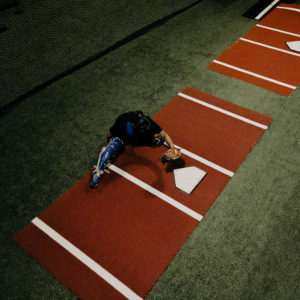
Use a repeatable test, not repeated attempts to manufacture your lowest number. Agree on the setup with your coach before recording:
- Specify the target. Record the base, field dimensions and receiver position. Do not mix throws to second with throws to third.
- Identify the test. Label game throws, showcase throws and practice throws separately; note whether a batter and runner were present.
- Keep the setup comparable. Record starting position, equipment and pitch location. A perfect practice feed is not the same task as a low, outside game pitch.
- Define the endpoints. For glove-to-glove video, identify pitch reception and reception by the target fielder. Do not start the clock at release.
- Keep the whole record. Log the number of attempts, times and accuracy. Report typical results and variation alongside the best result; retain misses rather than silently removing them.
For constant-frame-rate video, elapsed seconds equal the difference between ending and starting frame numbers divided by frames per second. At 120 frames per second, one frame interval is about 0.0083 seconds. That does not make every measurement accurate to 0.0083 seconds: visibility, contact-frame selection and recording quality still matter.
A useful log reads: date; field; target; game or practice; timing method; attempt times; accurate throws; observations. Before comparing two tests, check that these conditions match. If they do not, keep separate baselines instead of claiming an improvement.
Improve the part that is actually limiting the throw
Receiving and exchange: review whether the ball is secured consistently, whether the grip requires extra adjustment, and whether your feet and hands work together. Avoid rushing so aggressively that you lose the ball or your throwing direction.
Footwork and direction: examine unnecessary steps, balance and where the throw starts. Work with a coach on a movement sequence you can repeat from realistic pitch locations; the fastest-looking drill is not necessarily your best game solution.
Throwing and flight: consider throw speed alongside trajectory and accuracy. If getting the ball out is already efficient, simply demanding a quicker transfer may miss the larger limitation. Conversely, chasing radar velocity cannot fix every exchange problem.
Game usefulness: record whether the throw allows a tag, not merely whether it produces an attractive time. A throw into the runner's path and a throw pulling the fielder away deserve different notes, even if their times match. Pop time alone does not include the pitcher's delivery or the runner's start.
Choose one measurable priority, practice it within an appropriate coached workload, and retest under the same conditions. This article is a measurement guide, not a personalized throwing-volume or rehabilitation prescription.
For related coaching ideas, read our ten tips for catchers to improve pop times.
Catcher pop time by age: common questions
Is a 2.0-second pop time good for a high school catcher?
It can be a useful recruiting-level result when the test is credible and the throw is accurate. Compare it with the published targets above, but do not label every high school catcher below or above average from that number alone.
Should a youth catcher chase a sub-2.0 time?
Not without checking the distance, measurement and development context. A smaller-diamond result and a full-size-field result answer different questions. Build repeatable execution before treating a recruiting target as a youth deadline.
Turn your catcher measurements into a development plan
The TopVelocity Player Platform describes structured baseball training programs, video courses and progress-tracking tools. If you are comparing organized training options, start with the current player plans and match their listed material to your position and development needs.
Use your baseline, accuracy record, age, available equipment and current workload to assess fit. Do not assume a general baseball subscription includes a particular catcher-specific program: review the listed inclusions before registering. Training access is not a guarantee of a sub-2.0 pop time.


There are two different pop times one between innings ( without hitter our runner ) which I believe your times are based on and a “in game “ pop time when a catcher has to pop up clear the hitter and throw out the runner ,the true measure of a catcher Realmuto has the best a 1.83 pop time next best is 1,87 there is a high school player who threw a 1.79 and a “in game “ pop time of 1.84 at a PG event this past February 2024 in Hoover Alabama see @GilliganMickey
East Coast Pro 2025 Mickey Gilligan throws a 1.73 in game pop time coming close to the 1.71 all time in game pop time set by Patrick Bailey SF Giants in 2023 .@GilliganMickey