Pitching Velocity Quick Tip #2
October 3, 2010
This is the second velocity quick tip of the velocity quick tip series.
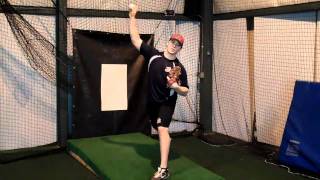
This quick tip covers the “Tilt” and how it is a key component to pitchers like Tim Lincecum’s total body mechanics. This tip will help support good hip to shoulder separation. It uses gravity to build more core torque at front foot strike. It is important though that you maintain balance when implementing the “Tilt” into your delivery.
Here is the article I wrote on Tim Lincecum and the Tilt to learn more about the effects of this key component of velocity.
These tips all are covered in depth in the Ace Pitcher Handbook and the 3X Velocity Camp Instruction Videos. If you are looking for velocity drills to help you become more total body in your pitching mechanics then you must consider purchasing this information.
If you have any questions please post your comments below.
The Pitching Key to Torque is in the “Tilt”
November 18, 2009
One of the main reasons a pitcher the size of Tim Lincecum, can generate as much velocity as a pitcher as tall as Randy Johnson, is because of core torque. The key to Tim Lincecum’s ability to create optimal torque is in his release point.
Tim has an “Over the top” release point and Randy has a “Sidearm” release point. I am not saying that every pitcher should throw the ball with a higher release point the shorter they are because there are benefits with all arm angles. What I am saying is a higher release point, using total body mechanics, will generate more core torque and in return increase velocity. Read more
Tim Lincecum Teaches Top Velocity
May 5, 2009
There are two forces that add velocity to a pitch:
Momentum
Rotational Torque
For momentum to effectively transfer to the ball, the pitcher must use all rotational pivots in order from the bottom up. The hips must rotate before the shoulders and the shoulders before the arm internally rotates. For this to happen effectively these pivots must be free to rotate completely. Notice the picture of Tim Lincecum at the bottom of the page (Tim Lincecum is a phenom because of his size and ability to reach his top velocity continuously.) Notice in the picture his weight is slightly leaning to his left. This would be like tilting an open door backwards so the open door slams closed due to gravitational forces. This gravitational pull is helping to create full range of motion in Tim Lincecum’s hips and shoulders at front foot strike. If he or the door was tilted the opposite way then these gravitational forces would work against his momentum by decreasing full range of motion in his rotational pivots. Using the force of gravity to increase the range of motion in your hips and shoulders will have a significant effect on your velocity. This is a big reason why Tim Lincecum can throw so hard for his size. He is working with the forces of nature to generate his power. Read more
Pitching and the Point of Balance
September 5, 2008
Most old school Coaches would talk about the importance of the “Balance Position” and how it leads to good pitch location. New school thought would say that this is stating the obvious and missing the main point. New school thought would then talk about balance as most importantly a means to efficient velocity. This is what I call, “Pitching and the Point of Balance.” Read more
Resisted Sprints and Effects on Kinematics and Sprint Speed
August 24, 2008
by Chad Englehart
Speed Training
Implied in any linear speed discussion with a Strength and Conditioning Specialist, is the concept of resisted speed training strategies. Some professionals consider resisted speed training as the most efficient sprint training technique on the planet, while other consider it not as effective because of a biomechanical stand point. Different resisted speed strategies include, towing, uphill sprints, sand sprints, and weighted sprints. Tahachnik (1992) explained that towing of weighted devices such as sleds and tires is the most common method of providing towing resistance for the enhancement of sprint performance, although the use of parachutes has also Read more