shoulders Pitching Articles

Here are some pitching articles on this important pitching velocity topic. This topic is currently open for discussion. You can either comment on the articles below or start a thread in the pitching forums.
Top 10 Pitching Velocity Workouts

by Brent Pourciau · February 8, 2012
So you need velocity and you need it now! I get it. I was you. This is why I put together the top 10 pitching velocity workouts here so you don’t have to continue searching through all the junk online to actually find something that works.
Yes, I am going to give you years and years of knowledge in this article for FREE! Why would I do this? Because once you read these top 10 pitching velocity workouts, you are going to learn that there is no better website out there when it comes to developing pitching velocity and maybe just maybe, you will trust me enough to become a member of 3X Pitching.
Before I list these top 10 pitching velocity workouts, I am going to first give you proof that strength training increases pitching velocity then I am going to show you why these workouts will work. To understand why these workouts are so effective and has been the secrets to helping many top level college and professional pitchers make it in their careers, I need to first show you the science that proves it and then give you a quick summary of how pitching velocity is enhanced. Read more
The Pitcher’s Cure To The Inverted W And L

by Brent Pourciau · December 30, 2011
So, you have been told you have the inverted W or L and that it is going to ruin your career but no one can tell you how to correct it? Don’t worry, you are about two minutes from the answer and the pitchers cure.
Before I remedy you and save your pitching career, we need to understand first why this is a problem. Unfortunately, there has been zero studies to date on this so called, “Red Flag.” This means it is all in just theory that your pitching career is over, so you really should not loss much sleep over this but it is an important subject so let’s fix the problem. Read more
A Major Pitching Velocity Headache

by Brent Pourciau · November 24, 2011
There is a major body part that can cause a major headache with pitching velocity. Most pitchers are completely unaware of this body part because it is the body part where awareness comes from. If you haven’t discovered it yet then it is the head. The head weighs between 8-12 pounds depending on how big the pitcher is. This means throwing the head around during the pitching delivery can be detrimental to pitching velocity. To help understand the positioning of the head through the entire delivery I am going to define where the head must be through the entire 3X mechanics. Read more
Conquer The Force Vector And Increase Pitching Velocity

by Brent Pourciau · October 30, 2011
The hardest component to conquer in the power pitching delivery is bar far the force vector. Most pitching coaches do not coach this component because they more than likely have no idea what it is. If you want to increase velocity quickly, or you need to increase velocity quickly, then spend your time training this secret component to pitching velocity. It is the foundation of the 3X approach to pitching.
If we compared the pitching delivery of a power pitcher to a high powered riffle then the force vector would be the barrel and triple extension would be the trigger. Without either one, your high powered riffle is junk. It also doesn’t matter how much gun powder is in the gun, without the barrel or the trigger, it is useless. Read more
Long Toss Vs 3X Power Throws

by Brent Pourciau · September 28, 2011
In the 3X Pre-Season program, the “Old School” approach of Long Tossing is replaced with the revolutionary 3X Power Throws. These throws revolutionize the traditional throwing practice of Long Tossing by incorporating the 3X Mechanics and velocity support. Once you learn this cutting edge approach to an in-season throwing program you will not want to go back to your old ways of Long Tossing.
The problem with the traditional Long Toss was discovered in the latest case study performed by the famous ASMI which was backed by the famous Dr. Andrews. You can learn more about this study here. The final results proved that the traditional long toss, along with the popular extreme long toss, not only is destructive to your pitching mechanics but it puts a tremendous amount of stress in the elbow. The 3X Power Throws were developed to eliminate this stress in the elbow while also promoting the 3X pitching mechanics. The results have been revolutionary. Read more
Top 10 Ways To Kill Your Pitching Velocity

by Brent Pourciau · September 18, 2011
Do you know what it takes to completely kill your pitching velocity? I get a lot of phone calls from guys who are desperate for help with their pitching velocity. Many of them are in college or pro ball who have experienced a major decrease in their pitching speed. I always try to reassure them that their velocity has not gone away, it has only been lost. I then inform them that it will take only a few minutes for us to discover what mechanical problems just killed their pitching velocity.
The key to discovering this loss in velocity is through video analysis, it is a critical tool to identifying what is killing pitching velocity. If you are experiencing similar issue or you are dealing with some of the issue listed below then post your video here in the forums for a FREE pitching velocity analysis and we together, will discover the number one issue that is killing your pitching velocity. Read more
Arm Path And Pitching Velocity

by Brent Pourciau · August 24, 2011
There is one “Arm Path” to pitching velocity that all high velocity pitchers take. This “Arm Path” begins not where conventional wisdom would believe, which is after hand break, but in the cocked position at front foot strike. The funky delivery here of Zach Outman is a great example of how the “Arm Path” of the high velocity pitcher works. What makes his pitching delivery so different is because he starts his delivery with his arms above his head instead of the conventional way, which is in the glove below the head. This out of the box approach makes it easier for him to get his throwing arm into the prefect cocked position at front foot strike, so he can generate his top velocity. Read more
Pitching Speed And The Glove

by Brent Pourciau · May 13, 2011
There is a lot of controversy around the glove side to pitching mechanics. Conventional Wisdom would coach the pitcher to pull down or pull around the glove side to launch the throwing arm into action. The problem is this would go against pure speed and classic physics.
The reality is that the glove arm to shoulder must act as a fulcrum for the shoulders during the throw to allow for efficient speed mechanics. To understand this we must first define the fulcrum. A fulcrum is the pivot about which a lever turns. The lever in pitching mechanics is the shoulders and also the hips but in this article we are only talking about the shoulders. The shoulders must swing like a door towards the target. Once they open then the arm must launch over the top of the door. If the pivot or fulcrum of the door is moving when the door is slamming closed then the door will not reach its top velocity. The same results would occur with other tools that use the fulcrum or pivot to swing a lever. Good examples similar to pitching, which I have used on this site, would be the catapult or mouse trap. Read more
3X Pitching And The Timing Factor

by Brent Pourciau · May 16, 2010
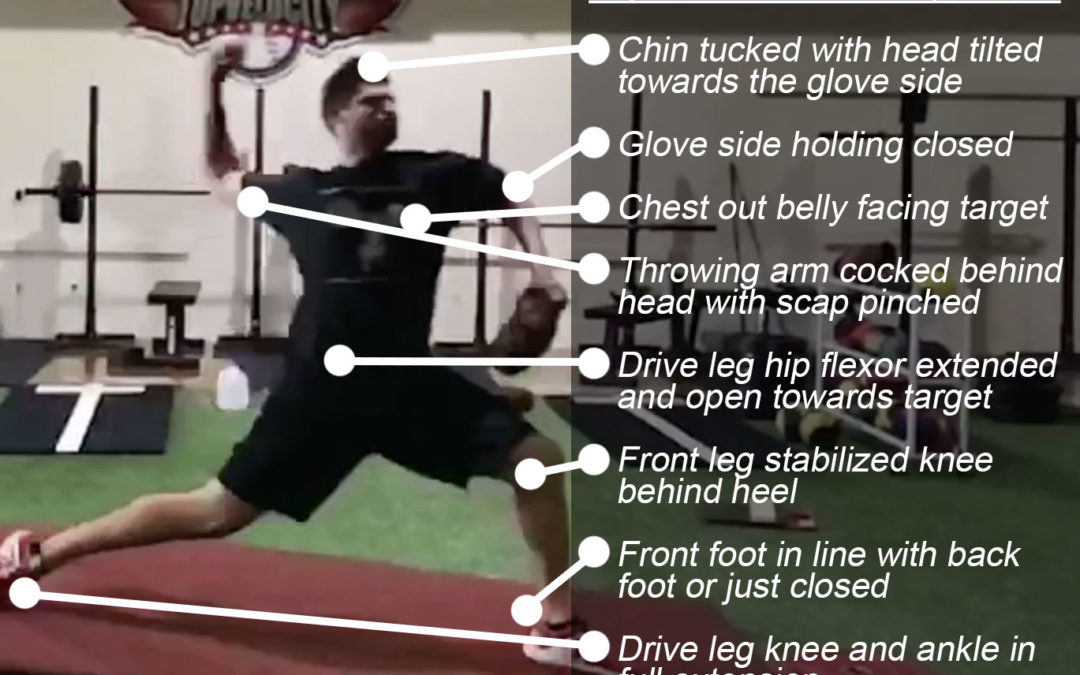
Triple Extension or 3X is the extension of the drive leg ankle, knee and hip flexor. Triple Extending the drive leg as the front side opens, drives the hips completely through to the target. If triple extension occurs quick enough and with enough force at the end of the stride, while the shoulders stay closed and relaxed, this will create optimal hip to shoulder separation.
Many studies have confirmed the correlation of hip to shoulder separation to pitching velocity (1,2,3,4,5). Therefore if you are going to increase velocity, you must learn to increase hip to shoulder separation by learning triple extension (3X) and 3X foot sync. Once you learn how to incorporate full triple extension into your pitching delivery, you will not see its benefits until you master the final factor. The final factor in learning any new muscle memory is the timing factor. The timing factor of 3X is critical to creating 40-60 degrees of hip to shoulder separation which research has shown to be the Major League average. Read more
The Phenomenon Of Speed Mechanics!

by Brent Pourciau · January 9, 2010
We have all heard about the importance of momentum in pitching but do we really know what it means and how it works? Pitching velocity is a product of momentum and rotational torque. I believe that top velocity is achieved when both momentum and rotational torque meet. The problem is we all understand rotational forces when throwing but momentum seems to be a lot harder to truly understand and implement into our deliveries. To truly understand momentum, I have coined a new term, along with its description. Read more
The Pitching Key To Torque Is In The “Tilt”

by Brent Pourciau · November 18, 2009
One of the main reasons a pitcher the size of Tim Lincecum, can generate as much pitching velocity as a pitcher as tall as Randy Johnson, is because of core torque. The key to Tim Lincecum’s ability to create optimal torque is in his release point.
Tim has an “Over the top” release point and Randy has a “Sidearm” release point. I am not saying that every pitcher should throw the ball with a higher release point the shorter they are because there are benefits with all arm angles. What I am saying is a higher release point, using total body mechanics, will generate more core torque and in return increase pitching velocity if done correctly. Read more
Comparison Of High Velocity And Low Velocity Pitch Deliveries

by Brent Pourciau · June 18, 2009
Stodden DF, Fleisig GS, McLean SP, Lyman SL, Andrews JR. Relationship of pelvis and upper torso kinematics to pitched baseball velocity. Journal of Applied Biomechanics 17(2):164-172, 2001.
Matsuo T, Escamilla RF, Fleisig GS, Barrentine SW, Andrews JF. Comparison of kinematic and temporal parameters between different pitch velocity groups. Journal of Applied Biomechanics 17(1): 1-13, 2001.
Stodden, DF, Fleisig, GS, McLean, SP, Andrews, JR. Relationship of Biomechanical Factors to Basebal Pitching Velocity: Within Pitcher Variation. Journal of Applied Biomechanics 21(1): 44-56, 2005 Read more
What Is Momentum Pitching?

by Brent Pourciau · June 14, 2009
The online world of pitching experts have been throwing around the buzz word “Momentum pitching” recently. This isn’t anything new unless you are up to date on the breakthroughs of pitching science. Pitchers have been trying to find better ways to generate more momentum in their deliveries for years but what is changing is the science behind this matter.
During the prime of the likes of Nolan Ryan, the popular way of generating more momentum back then was the “Stand Tall and Fall” style developed by Nolan Ryan and his pitching coach Tom House, who may have coined the term. This proceeded the popular style of “Drop and Drive” used by the great Tom Seaver. These two styles of pitching are still used today. What is changing is pitching mechanics are evolving from an art form into the world of science. Read more
Triple Extension Pitching Creates Optimal Separation

by Brent Pourciau · June 6, 2009
For all of those pitchers who are trying to develop more separation in back hip to back shoulder, you will only achieve this with explosive triple extension of the drive leg. “Triple Extension” is the extension of the ankle joint, knee joint and the hip flexor. You must perform this in your drive leg so your back hip can open completely to the target. If you keep your shoulders and weight back while aligning your Force Vector and once your Force Vector is linear you perform”Triple Extension,” optimal “Separation” will occur. Read more
Why Pitchers Should ICE Their Arms?

by Brent Pourciau · May 9, 2009
There is a lot of controversy around pitchers and icing their arms post game. After surgery I was very strict when it came to icing post game. I know that it isn’t enough for me here to just say that, “Hey, I did it, so you should too.” So, I took some time to research the web and I found several websites reference the work of Dr. Meeusen from Antwerp, where I played some professional baseball. He based his life study around icing as a means to help heal a damaged muscle. His documentation describes how ice can be effective and where it can cause problems.
Research by Dr. Meeusen on Icing a Pitchers Arm
Tim Lincecum Teaches Top Velocity

by Brent Pourciau · May 5, 2009
There are two forces that add velocity to a pitch:
- Momentum
- Rotational Torque
For momentum to effectively transfer to the ball, the pitcher must use all rotational pivots in order from the bottom up. The hips must rotate before the shoulders and the shoulders before the arm internally rotates. For this to happen effectively these pivots must be free to rotate completely. Notice the picture of Tim Lincecum at the bottom of the page (Tim Lincecum is a phenom because of his size and ability to reach his top velocity continuously.) Notice in the picture his weight is slightly leaning to his left. This would be like tilting an open door backwards so the open door slams closed due to gravitational forces. This gravitational pull is helping to create full range of motion in Tim Lincecum’s hips and shoulders at front foot strike. If he or the door was tilted the opposite way then these gravitational forces would work against his momentum by decreasing full range of motion in his rotational pivots. Using the force of gravity to increase the range of motion in your hips and shoulders will have a significant effect on your velocity. This is a big reason why Tim Lincecum can throw so hard for his size. He is working with the forces of nature to generate his power. Read more
The Pitching Windup Vs Stretch

by Brent Pourciau · March 8, 2009
I get this question a lot, “the windup vs the stretch, what is better?” The problem is the windup is almost sacred to the game of baseball but it really has no purpose besides a kind of confidence builder on the mental state of the pitcher. The windup represents the old style of pitching from back in the day when the pitchers would use the windup to get their arms moving faster like in the video clip here of Dizzy Dean. Now that we have learned that doing this is destructive to pitching velocity, the windup has become just an extra step to throwing in the stretch. Read more
The Split Perspective Of Separation

by Brent Pourciau · February 17, 2009
Separation is a major component to developing top velocity and longevity. Separation means having separation from your back hip to back shoulder at front foot strike. Notice the picture here of Felix Hernandez. His back hip is pointing towards home plate and his back shoulder is pointing towards second base. This creates torque in the core. You can see the stretching in his jersey around the stomach area. Having more torque in the core instead of the shoulder of the arm will lead to more velocity and a healthier arm. Read more
The Hip Slide To Pitching Velocity

by Brent Pourciau · February 12, 2009
The biggest problem I find in young pitchers is that they have poor separation in their hips to shoulders. There are many articles on this site covering the pitching component “Separation.” It is so important because having separation from your back hip to back shoulder before the shoulders rotate to the plate, is critical for velocity and the health of your arm. What “Separation” does is it builds core torque. It puts more torque in the big muscle groups of the core, instead of mainly in the small muscle groups of the shoulder. Read more
Pain In Triceps And Biceps When Pitching

by Brent Pourciau · February 1, 2009

* If you have shoulder pain and you would like to heal the rotator cuff without surgery checkout this page.
So you have pain in triceps and or biceps when pitching and it has more than likely been hurting for a while. You are searching the web for answers because you need this pain to go away so you can get back to business. I get it! I was you in my career.
When I had this problem and I couldn’t find the answers to a quick fix of the problem, I just looked for ways to hide the pain. I was taking Advil almost everyday and I started to have to take tons more of it because the pain was getting worse. The pain first started in my elbow and then it moved up my bicep into my shoulder.
It got so bad that I had to take the maximum dose of pain killers, along with icy hot, and in between innings I had to hit my arm so I would feel the pain of the hit and not the pain coming from my throbbing arm. This was the day that my rotator cuff tore and my career completely stopped. I was shocked and depressed at this time in my life because I had let the pain get so bad, that it ended my career.
I Want to Help You Remove This Pain
I am writing this article here to help you because I wish someone would have helped me at that point in my pitching career when the pain first started. If you have pain in your lower, or upper bicep, or your lower or upper tricep and maybe even in the back or front of your upper forearm, you are overusing and abusing your arm. If you have anyone or all of these pains, then you need to stop and listen to your body.
Pain is your bodies way of telling you that something is wrong. Pain does not just go away. It will only get worse, like it did in my career, if you do not make some changes immediately. Unfortunately, you should have not waited this long to make the changes but better late than never! Read more